Revenue teams do not need more data. They need the right data, in the right format, at the right time. That is why choosing the right b2b saas dashboard features usa teams rely on can make the difference between guessing at growth and managing it with confidence.
In B2B SaaS, revenue does not come from one department alone. Sales drives pipeline, marketing fuels demand, customer success protects renewals, and finance monitors growth efficiency. A strong dashboard brings those functions together around shared metrics that actually influence revenue outcomes.
This article covers the most important dashboard features US revenue teams should track, why they matter, and how to build a dashboard people will actually use.
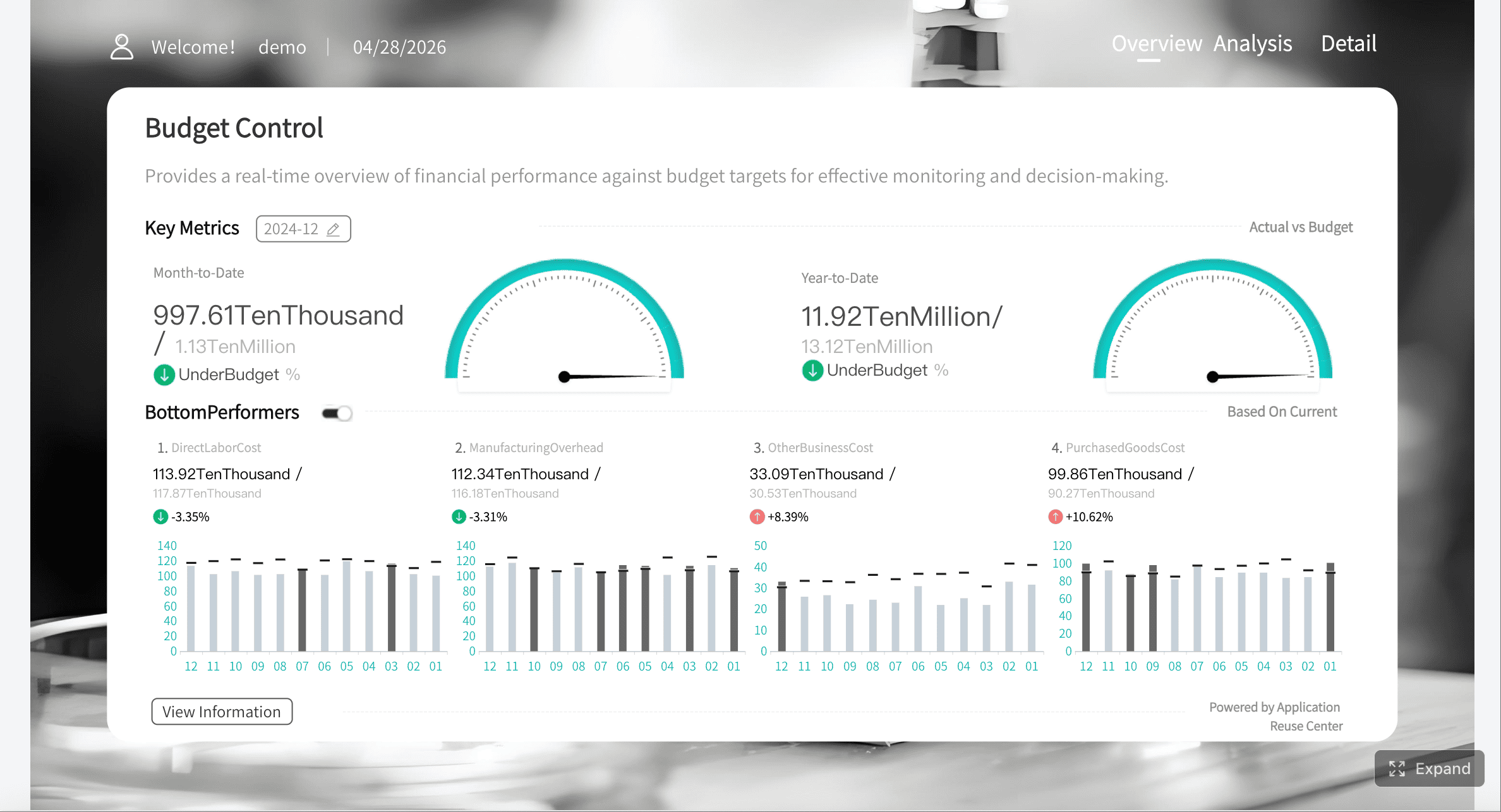
All dashboards in this article are created by FineBI
What B2B SaaS Dashboard Features USA Revenue Teams Should Prioritize
A revenue dashboard should do more than display charts. It should help teams answer practical questions quickly:
Is pipeline strong enough to hit next quarter’s target?
Where are leads getting stuck or dropping out?
Are deals closing fast enough to support forecast timing?
Is growth coming from new business, expansion, or both?
Are churn risks increasing before renewals are due?
Is go-to-market spend producing efficient recurring revenue?
For sales teams, a dashboard should show pipeline health, conversion performance, and forecast risk. For marketing, it should connect campaign and channel activity to qualified opportunities and revenue. For customer success, it should highlight retention, product adoption, renewal timing, and expansion potential. For finance and leadership, it should provide a reliable view of recurring revenue growth, efficiency, and forecast accuracy.
US-based teams often need especially clear visibility because the market is highly competitive, buying cycles can vary by segment, and investor or board expectations often demand tight forecasting discipline. Teams need to track:
Pipeline health
Conversion efficiency
Retention trends
Expansion performance
Revenue pacing
There is also an important difference between reporting activity and tracking decision-driving metrics. Activity reporting tells you what happened, such as calls made or emails sent. Revenue metrics tell you whether those activities are producing pipeline, closed-won deals, renewals, and profitable growth. A useful dashboard focuses on what helps leaders take action, not just what fills a screen.
10 Dashboard Features That Revenue Teams Need to Track
1. Pipeline coverage and stage movement
Pipeline coverage is one of the most important indicators of short-term revenue health. It shows whether the value of open opportunities is sufficient to support upcoming targets. If a team needs $1 million in bookings next quarter and historical conversion rates require 3x coverage, the dashboard should reveal whether enough qualified pipeline exists now.
Stage movement matters just as much. A dashboard should track how deals move from one stage to the next, where they stall, and how long they age in each stage.
Key things to monitor include:
Total open pipeline by quarter or month
Pipeline coverage ratio versus quota
Opportunity volume and value by stage
Average age of deals in each stage
Stage-to-stage progression rates
Bottlenecks by rep, team, or segment
This feature helps revenue teams detect problems early. A pipeline that looks large on paper may still be weak if too many deals sit in late stages without movement. For US SaaS teams with aggressive quarter-end targets, that kind of visibility is critical.
2. Lead-to-opportunity and opportunity-to-win conversion rates
Conversion metrics reveal where revenue leaks happen. If lead volume looks healthy but opportunities remain low, the issue may be qualification or targeting. If many opportunities are created but very few close, the problem may be positioning, pricing, competition, or sales execution.
A strong dashboard should show:
Lead-to-MQL conversion
MQL-to-SQL conversion
Lead-to-opportunity conversion
Opportunity-to-win conversion
Funnel conversion by source
Funnel conversion by segment, geography, and team
This matters because not all channels perform equally. Paid search, outbound prospecting, partner referrals, product-led signups, and events may all generate leads, but their downstream revenue impact can differ significantly.
For USA revenue teams, segment comparisons are especially useful. Enterprise versus mid-market, East Coast versus West Coast, and inbound versus outbound may each show very different conversion patterns. Those differences can guide budget allocation, headcount planning, and funnel optimization.
3. Average sales cycle length
Sales cycle length measures how long deals take to move from first touch to closed won. This metric affects forecasting accuracy, rep productivity, and cash flow timing.
A dashboard should display:
Average sales cycle by segment
Median time to close
Cycle length by source or channel
Cycle length by product line
Delays between major stage transitions
When the sales cycle starts stretching, it often signals friction in the buying process. That friction might come from poor qualification, legal delays, weak discovery, pricing issues, or longer procurement processes.
For US SaaS businesses, where quarterly targets and investor expectations are common, longer cycles can create forecast volatility. If a team expects deals to close in 45 days but actual close time has drifted to 70, revenue projections can quickly become unrealistic. Monitoring this feature helps leaders adjust forecasts and fix process issues before they impact results.
4. Win rate by segment and channel
Overall win rate is useful, but win rate by segment and channel is far more actionable. It helps teams understand which customer profiles and acquisition routes lead to the strongest outcomes.
A dashboard should break out win rate by:
Industry
Company size
Region
Product interest
Lead source
Partner channel
Sales territory
Rep or team
This feature supports smarter decision-making. If enterprise healthcare accounts win at a much higher rate than SMB retail, that may justify changes in messaging, targeting, or territory design. If referrals outperform paid channels, marketing can shift budget accordingly.
Win rate insights also help sales leadership coach teams more effectively. A low win rate in a specific segment may point to competitive pressure, poor fit, or insufficient enablement. The dashboard turns assumptions into measurable patterns.
5. Monthly recurring revenue growth
Monthly recurring revenue, or MRR, is central to SaaS performance. A useful dashboard should not just show total MRR. It should break MRR growth into its key components so teams can see what is actually driving change.
That includes:
New MRR
Expansion MRR
Contraction MRR
Churned MRR
Net new MRR
MRR growth rate over time
This view connects top-of-funnel activity to recurring revenue outcomes. Marketing and sales may generate bookings, but the real growth picture becomes clearer when leaders can see how much recurring revenue was added, expanded, reduced, or lost.
For US revenue teams, this feature matters because fast growth can hide weak retention, and stable retention can hide weak acquisition. Looking at MRR in one combined view helps leaders understand whether growth is balanced and sustainable.
6. Customer acquisition cost and payback period
Customer acquisition cost, or CAC, shows how much the business spends to acquire new customers. Payback period shows how long it takes to recover that cost from gross profit generated by those customers. Together, these metrics help leaders evaluate growth efficiency.
A dashboard should track:
CAC by channel
CAC by segment
Fully loaded CAC including sales and marketing costs
CAC trend over time
Payback period by cohort
CAC versus average contract value or LTV
These are essential b2b saas dashboard features usa companies need because growth in the US market is expensive. Paid media, outbound teams, events, and partnerships all require meaningful investment. Without CAC visibility, teams may scale channels that generate pipeline but not efficient revenue.
Payback period is especially useful for planning. If payback is increasing, the company may need to rethink spend allocation, pricing, or customer targeting. Efficient growth is not just about adding revenue. It is about adding revenue in a financially sustainable way.
7. Net revenue retention and gross revenue retention
Net revenue retention, or NRR, shows how much recurring revenue from existing customers is retained and expanded over time. Gross revenue retention, or GRR, measures retained revenue before expansion is included. Both metrics are essential for understanding long-term growth quality.
A dashboard should clearly show:
NRR by cohort
GRR by cohort
Retention trends over time
Expansion impact on retained revenue
Retention by segment, plan, or customer size
These metrics matter because they reveal whether growth depends only on constant new logo acquisition or whether the customer base itself is compounding in value. A company with strong NRR can grow more efficiently because existing customers help drive expansion.
For revenue teams, these metrics also create a shared view across departments. Sales may focus on acquisition, while customer success focuses on renewals and expansion. NRR and GRR connect both motions into one measurable outcome.
8. Churn signals and renewal risk
Churn rarely appears without warning. Most at-risk accounts show signals before they cancel or downsize. A good dashboard surfaces those signals early enough for teams to act.
Common churn indicators include:
Low product usage
Declining login frequency
Support escalation volume
Poor onboarding completion
Low stakeholder engagement
Dropping health scores
Contract renewal dates approaching without activity
Reduced seat usage or feature adoption
A dashboard feature for renewal risk should make it easy to prioritize action. That may include risk scoring, account-level alerts, or views segmented by customer success manager, account size, or renewal month.
This matters because saved renewals often have a greater revenue impact than generating a new lead. For US SaaS companies facing competitive markets and rising acquisition costs, preventing avoidable churn is often one of the fastest ways to protect growth.
9. Forecast attainment and revenue pacing
Revenue teams need to know not just what they hope to close, but how expected revenue compares to quota, plan, and actual performance over time. Forecast attainment and pacing dashboards make this visible.
Useful views include:
Forecast versus quota
Forecast versus plan
Actuals versus forecast
Bookings pacing by month and quarter
Commit, best case, and pipeline categories
Historical forecast accuracy
This feature improves confidence in near-term projections. If bookings are pacing behind plan by mid-quarter, leaders can respond sooner with pricing adjustments, pipeline generation efforts, or deal support. If forecasts consistently miss reality, the dashboard can expose where assumptions are breaking down.
In many US organizations, forecast discussions shape hiring, budget decisions, board reporting, and investor communication. That makes accurate pacing visibility a core revenue operations requirement, not a nice-to-have.
10. Expansion and upsell performance
Expansion revenue is a major growth lever in SaaS. A dashboard should show how much revenue comes from existing accounts and which factors contribute to successful upsells, cross-sells, or plan upgrades.
Important expansion metrics include:
Expansion MRR or ARR
Upsell rate by account segment
Cross-sell adoption by product line
Expansion by customer age or cohort
Expansion by customer success manager or account team
Time from initial close to first expansion
This feature helps teams identify what drives account growth. For example, customers using a certain product module may upgrade more often. Accounts above a certain adoption threshold may expand faster. Teams can use that information to improve onboarding, product education, and account planning.
Expansion performance also gives leadership a clearer picture of revenue quality. Growth from existing customers is often more efficient and more predictable than growth from net-new acquisition alone.
Why These Dashboard Features Matter for US Revenue Operations
Better cross-functional alignment
One of the biggest advantages of a strong dashboard is that it creates a shared source of truth. Sales, marketing, customer success, finance, and leadership often work from different tools and different definitions. That leads to conflicting interpretations of performance.
A well-built dashboard aligns teams around common metrics such as:
Pipeline coverage
Conversion rates
MRR growth
Retention
Forecast attainment
When everyone sees the same numbers, discussions become more productive. Teams spend less time debating data quality and more time solving actual revenue problems.
Faster decision-making
Revenue issues become harder to fix the longer they remain hidden. Dashboards that update consistently help teams respond before quarter-end pressure takes over.
That speed matters when teams need to:
Reallocate marketing spend
Change outbound targeting
Add support to late-stage deals
Escalate at-risk renewals
Adjust forecast expectations
Refocus customer success outreach
Instead of waiting for monthly reports or post-quarter analysis, teams can make changes while there is still time to influence results.
More accurate forecasting and planning
Planning depends on visibility. If leaders cannot see current pipeline quality, conversion trends, churn risk, and revenue pacing in one place, forecasts become overly optimistic or unnecessarily conservative.
The right dashboard features support better planning by grounding decisions in real-time performance. Annual budgets, quarterly targets, hiring plans, and territory models all become more reliable when they are based on current pipeline and retention data rather than outdated assumptions.
How to Build a Dashboard Teams Will Actually Use
Focus on leading and lagging indicators
The best dashboards combine both leading and lagging metrics. Lagging indicators such as closed revenue, churn, and MRR show outcomes. Leading indicators such as pipeline creation, stage movement, product adoption, and renewal risk show what is likely to happen next.
A balanced dashboard should include:
Activity and pipeline inputs
Funnel conversion metrics
Sales velocity indicators
Retention and health metrics
Revenue outcomes
This approach helps teams act earlier. It also prevents dashboards from becoming collections of vanity metrics that look busy but offer little strategic value.
Segment data for better insights
Revenue trends are rarely uniform. What works in one market, segment, or channel may underperform in another. That is why segmentation is essential.
Break dashboard data down by:
Industry
Company size
Market
Region
Deal size
Source or channel
Product
Customer cohort
Segmentation makes it easier to find the true drivers behind strong or weak performance. Instead of concluding that win rate is falling overall, leaders may discover it is only falling in one segment. That leads to faster, more precise action.
Keep ownership and definitions clear
Even the best dashboard loses value if teams do not trust the data. Metric definitions must be standardized across departments so everyone measures the same thing the same way.
Teams should clearly define:
What counts as an opportunity
How win rate is calculated
How churn and contraction are classified
How MRR and ARR are recognized
How often data refreshes
Which systems feed the dashboard
Ownership matters too. Someone should be accountable for maintaining data integrity, updating definitions when needed, and making sure teams know how to use the dashboard to take action.
Common Dashboard Mistakes to Avoid
Many dashboards fail not because they lack data, but because they lack focus. Common mistakes include:
Tracking too many metrics without tying them to revenue outcomes
More charts do not mean better insight. Prioritize metrics that support decisions.
Mixing inconsistent definitions across departments
If marketing, sales, and finance define pipeline or churn differently, trust breaks down quickly.
Reviewing lagging metrics too late to influence the quarter
By the time closed revenue misses target, the real issue likely started much earlier.
Ignoring retention and expansion in favor of new business alone
SaaS growth depends on the full customer lifecycle, not just new logo acquisition.
Building dashboards executives understand but frontline teams cannot act on
A dashboard should support strategic visibility and day-to-day action, not just high-level reporting.
The most effective b2b saas dashboard features usa teams use are the ones that connect daily execution to revenue impact. When a dashboard shows pipeline strength, funnel performance, retention risk, and recurring revenue growth in one clear system, teams can make faster decisions and plan with more confidence.
For B2B SaaS companies in the US, that kind of visibility is not optional. It is a competitive advantage.
FAQs
A strong revenue dashboard should track pipeline coverage, stage movement, conversion rates, sales cycle length, win rate, retention, expansion revenue, and overall revenue pacing. These metrics help teams spot risks early and make faster decisions.
Pipeline coverage shows whether current opportunities are enough to support future quota. For USA teams working under tight quarterly targets, it helps reveal forecast risk before the quarter is at risk.
A dashboard improves forecasting by combining pipeline health, deal aging, conversion trends, and sales cycle data in one place. This makes it easier to judge whether expected revenue is realistic or slipping.
Conversion tracking between lead, MQL, SQL, opportunity, and closed-won stages is essential for finding funnel leaks. Segmenting those metrics by channel, geography, or team makes the root cause clearer.
Retention and expansion metrics show whether growth is sustainable beyond new customer acquisition. They help customer success, sales, and leadership monitor churn risk, renewal timing, and upsell opportunities.
Product Trial
FineReport
Pixel-perfect reports · Interactive dashboards · Easy data entry · Digital twins