Most dashboards show you what happened. The best ones tell you what to do next. If your marketing dashboard doesn’t map to your funnel, you’re just visualizing confusion at scale.
The Real Problem with Marketing Dashboards Isn’t the Data.
It’s the Default Thinking. You’ve seen it: dozens of marketing dashboards packed with charts, metrics, heatmaps, and filters. CTR here, ROI there, CAC down below. And yet none of them answered a single strategic question. That’s because most dashboards are built backwards: from data sources → KPIs → chart types → eventually slapped into a UI. But marketers don’t think that way. Marketers think in goals, funnels, and actions.That’s why your dashboard should too.
A Dashboard Should Work Like a Funnel, Not a Report
Most marketing dashboards today are designed like static reports: they present data in isolation, layer on visuals, and often overwhelm the viewer with disconnected KPIs. But marketing doesn’t operate in fragments, it operates in flows. And the dashboard should reflect that.
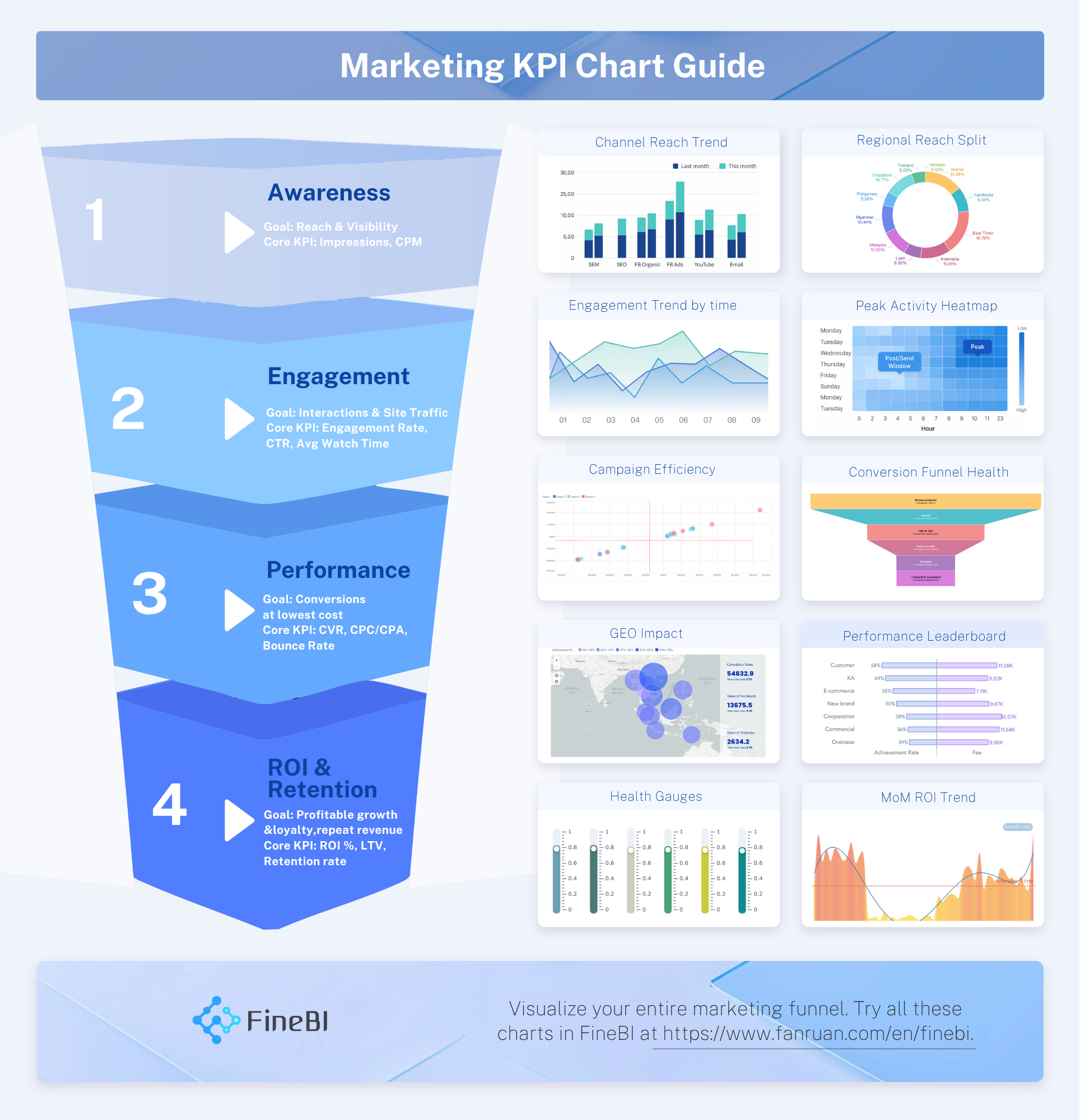
A truly effective marketing dashboard is structured according to the conversion funnel, not data sources, not team silos. Each stage of the funnel corresponds to a specific set of decisions:
Awareness: Where is attention growing? What’s the cost of that attention?
Engagement: Who is interacting, when, and with what content?
Performance: Which campaigns are converting most efficiently?
ROI & Retention: Is the business growing profitably over time?
Every chart in the dashboard should tie to a stage in this journey. Every metric should answer a real marketing question. Every visualization should make the next move obvious: scale, pause, shift, or fix.
Dashboards that mix funnel stages, showing impressions, CTR, and ROI on the same screen, create noise, not insight. Dashboards that show KPIs without context, like a CTR of 2.1% with no target line, require guesswork, not decisions. And dashboards that bury core signals under filters and widgets risk becoming internal reporting graveyards. Instead, a well-structured dashboard guides the marketer like a funnel itself:
From reach → to interaction → to conversion → to long-term value.
This is the philosophy embedded in marketing analytics approach. By aligning dashboard logic with marketing logic, teams move faster, think clearer, and act with confidence.
Chart Choice Isn’t Aesthetic. It’s Strategic.
Each funnel stage has specific visual logic. The goal isn’t just to visualize data, it’s to force clarity. Here’s how we chose the most high-leverage charts:
Awareness: Visibility vs Cost
Chart 1: Channel Reach Trend. Stacked column of impressions over time, broken by channel.
Why it works: Tells you what to scale, what to fix, what to kill.
ROI & Retention: Profit Over Time
Chart 7: MoM ROI Trend (Area). Revenue vs spend with ROI% line.
Chart 8: Health Gauges. Visual dials for CAC, LTV, Payback Period.
Why it works: Makes it easy to defend budgets, or slash what’s not working.
Diagnostics Layer (Bonus Layer for Senior Marketers)
Chart 9: Geo Campaign Map. Bubble map by conversion rate/spend.
Chart 10: Performance Leaderboard. Ranked bar chart for top X campaigns by ROI/CVR.
Why it works: Adds context. Helps explain why things move.
Three Don’ts That Kill Decision-Making
Don’t blend funnel stages in one page.
Awareness and ROI have different metrics, velocity, and audiences. Separate them.
Don’t show charts without targets.
A CTR of 2.1% is meaningless unless your benchmark is 3.5%. Add reference lines.
Don’t design for analysts, design for decisions.
If a CMO can’t make a call in 5 seconds, your dashboard failed.
Why Self-Service BI Tools Fall Short Without Structure
It’s not about having drag-and-drop dashboards or connecting to 50 data sources. That’s table stakes. The difference comes down to:
Does your dashboard mirror your business logic (e.g., marketing funnel)?
Are KPIs embedded with directional cues (target lines, MoM movement, warning icons)?
Can any stakeholder look at one screen and say:
→ “We should scale this.”
→ “We need to fix that.”
→ “We’re wasting money here.”
FineBI gives you the flexibility to build funnel-aligned dashboards with semantic modeling, responsive drill-downs, and real-time cross-source metrics, but structure is what makes it smart.
Bottom Line: Don’t Visualize the Chaos. Funnel It.
If your marketing dashboard is just a prettier spreadsheet, it’s wasting everyone’s time.
If it walks your team through the funnel, one decision at a time, it becomes a weapon.
Instead of downloading a static template, experience the full interactive version yourself.
Build your own marketing dashboard directly inside FineBI, test the charts, connect your data, and explore how self‑service BI turns every KPI into a decision.
Access a wealth of case studies, industry insights, and solution guides to accelerate digital transformation.
FAQ
What is a funnel based dashboard?
A funnel based dashboard organizes marketing metrics according to each stage of the customer journey such as Awareness, Engagement, Conversion, and Retention rather than mixing them on a single page. This layout makes it easier for decision makers to spot bottlenecks, assess KPI flow, and take action quickly.
Why is separating funnel stages important?
Each funnel stage has different goals, audiences, and KPIs. Mixing them in one view can confuse stakeholders and dilute insights. By separating them like tracking CTR in Awareness vs. ROI in Retention, dashboards become more actionable, aligned, and decision ready.
What makes a marketing dashboard decision ready?
A decision ready dashboard prioritizes clarity over complexity. It shows KPIs with context such as benchmarks, reference lines, or expected values and maps each chart to a specific funnel stage. Executives should be able to answer “What’s working, what’s not, and what next” in under 5 seconds.