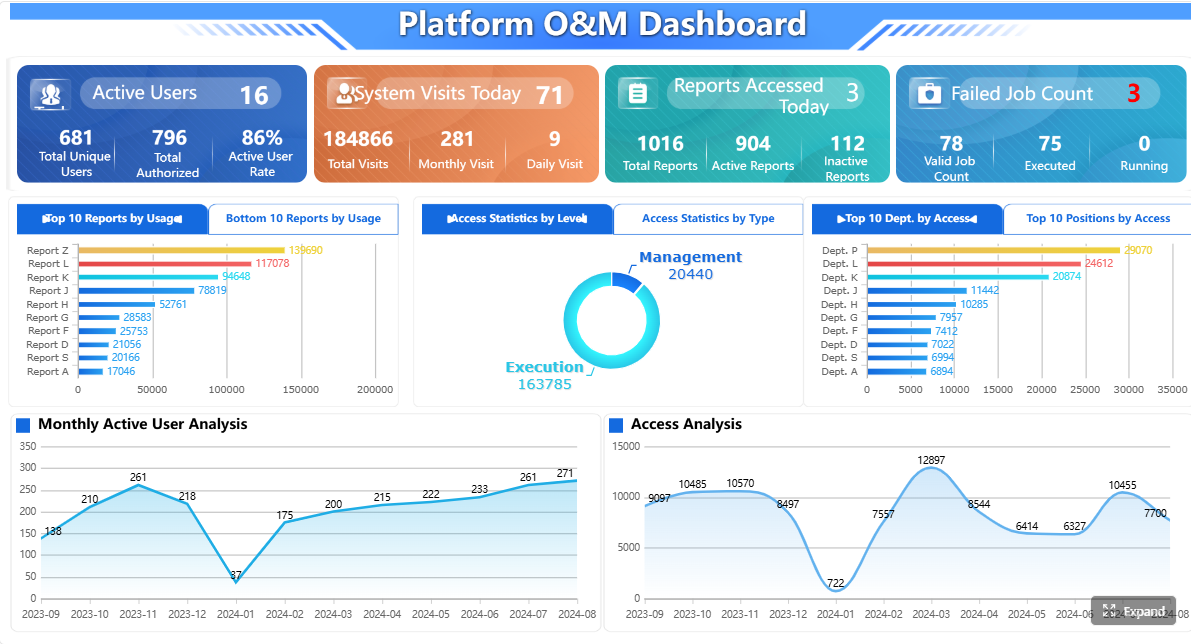
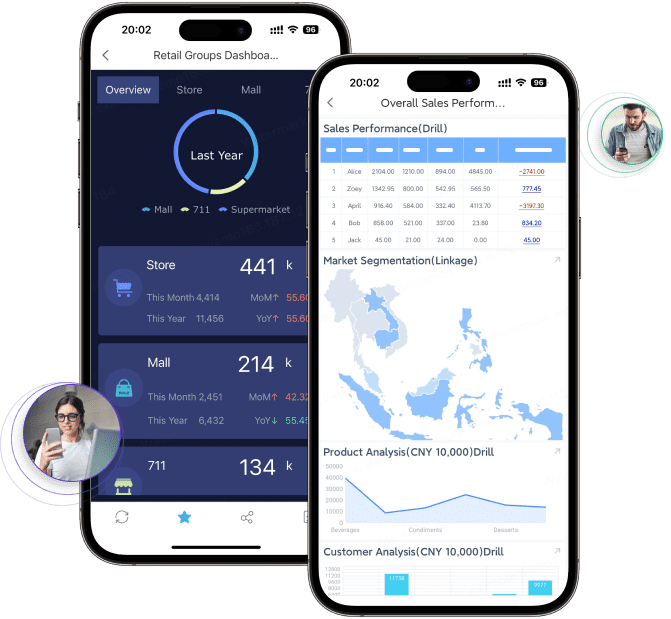
FineReport is an enterprise reporting and dashboard platform that helps supply chain teams turn operational data into real-time analytics, KPI monitoring, and decision-ready visual reports.
Click To Try The Dashboard
Top 10 supply chain management platforms compared for planning, execution, and analytics
Platform-by-platform comparison snapshot
Below is a practical comparison of 10 leading supply chain management software services for 2026, with an emphasis on planning, execution, and analytics. The list includes end-to-end suites, planning specialists, execution-first platforms, and analytics tools that strengthen supply chain visibility. FineReport is included because many organizations need stronger reporting and decision support on top of their ERP, WMS, TMS, and procurement systems.
1. FineReport
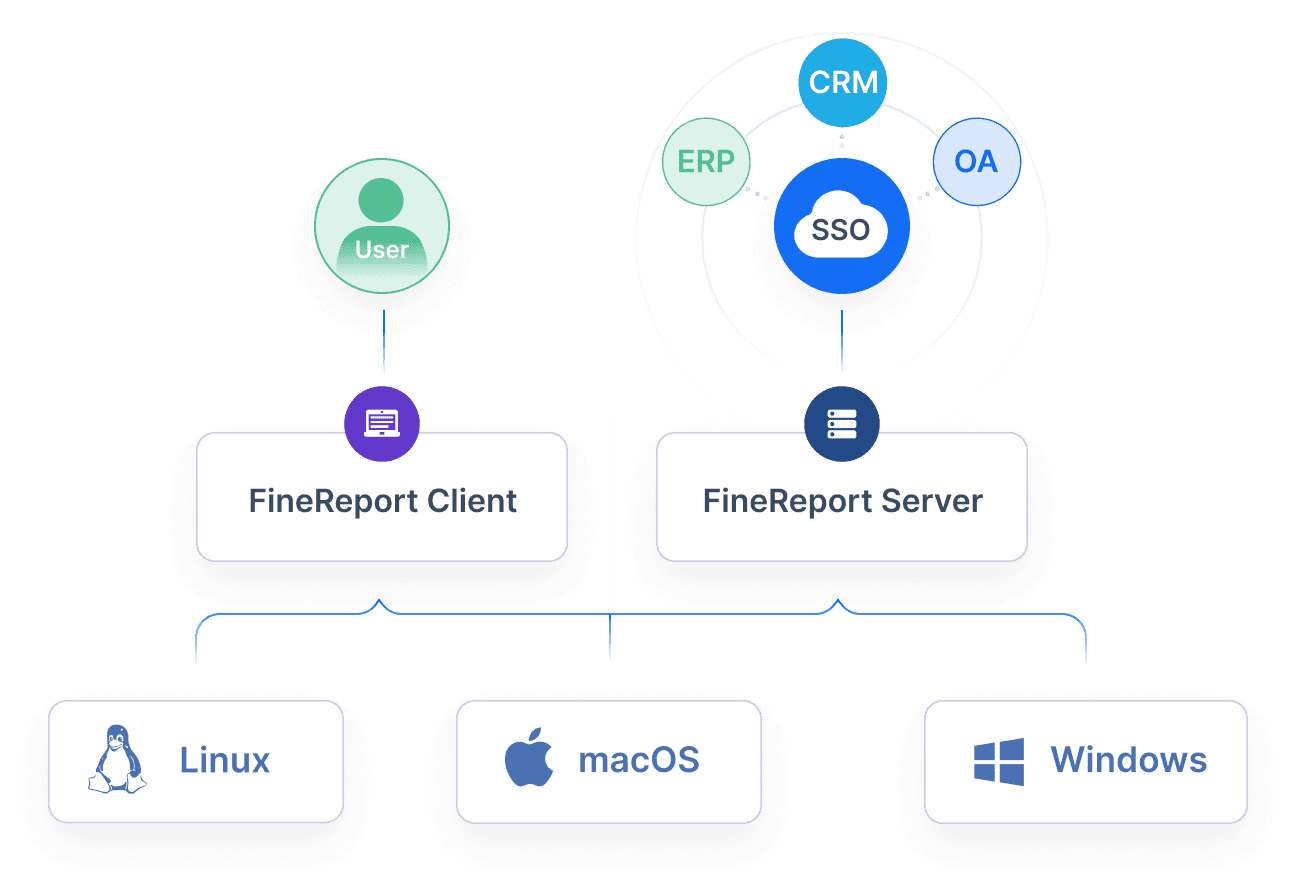
One-sentence overview:FineReport is a reporting and analytics platform that strengthens supply chain decision support by unifying data from ERP, WMS, TMS, procurement, and inventory systems into interactive dashboards and reports.
Key Features:
Real-time supply chain dashboards
KPI tracking for inventory, procurement, fulfillment, and logistics
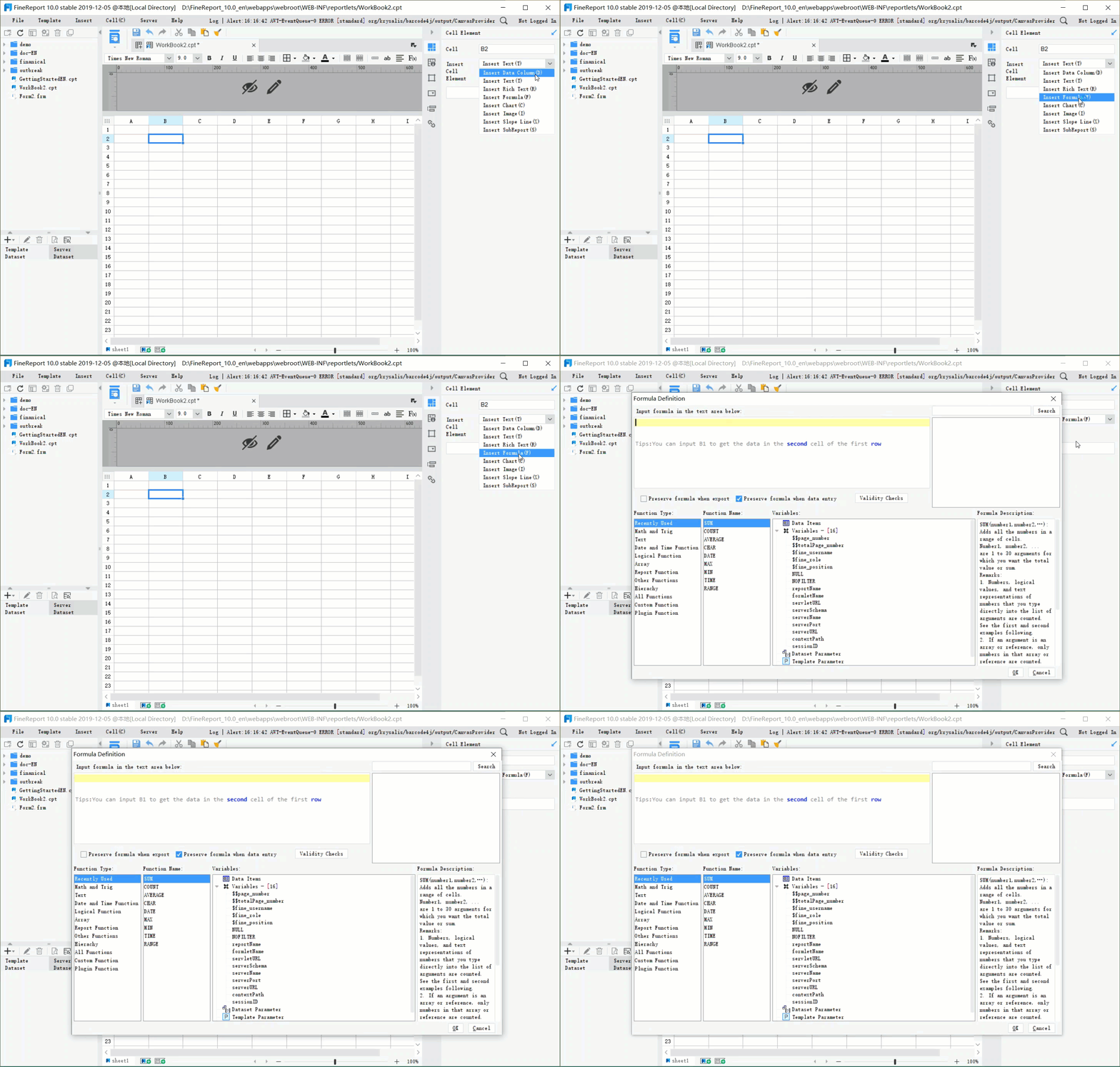
Flexible report design for planners, operations managers, and executives
Exception monitoring and visual analytics for decision support
Pros & Cons:
Pros: Strong reporting flexibility, fast dashboard creation, useful for organizations that need better visibility without replacing core SCM systems
Cons: Not a full transactional SCM suite for planning or execution, best used alongside ERP and operational platforms
Best For (Target user/scenario): Companies that already run core supply chain systems but need stronger analytics, reporting, and management visibility across planning and execution data.
2. SAP Integrated Business Planning and SAP SCM
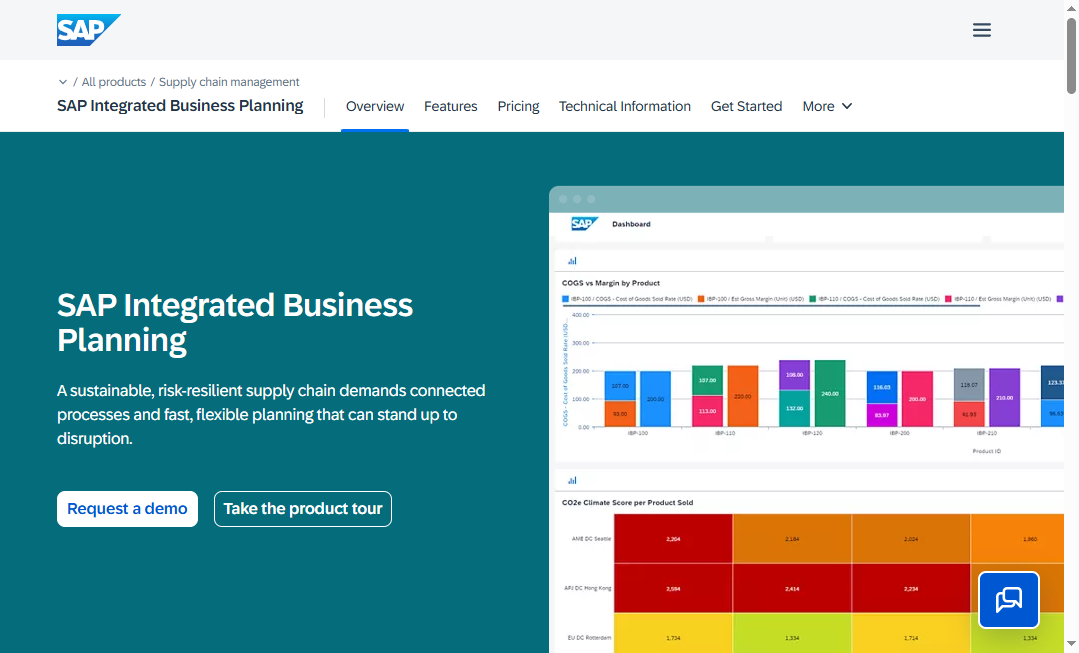
One-sentence overview: SAP offers broad supply chain coverage for enterprises that need integrated planning, manufacturing, logistics, and network-wide orchestration.
Key Features:
Demand planning and supply planning
Inventory optimization and S&OP support
Manufacturing and logistics integration
Global visibility across complex operations
Deep ERP connectivity for SAP-centric organizations
Pros & Cons:
Pros: Strong end-to-end breadth, enterprise-grade scalability, robust process depth
Cons: High implementation complexity, significant change management effort, premium pricing
Best For (Target user/scenario): Large enterprises with global operations, especially organizations already standardized on SAP.
3. Oracle Fusion Cloud SCM
One-sentence overview: Oracle Fusion Cloud SCM is a comprehensive cloud suite designed for planning, procurement, manufacturing, order management, and logistics execution.
Pros: Broad functional footprint, modern cloud architecture, strong finance and ERP alignment
Cons: Can be resource-intensive to deploy, may exceed the needs of smaller teams
Best For (Target user/scenario): Mid-market to enterprise organizations seeking a unified cloud platform across supply chain and back-office processes.
4. Blue Yonder
One-sentence overview: Blue Yonder is one of the strongest options for companies that prioritize AI-driven planning, retail execution, and fulfillment optimization.
Key Features:
Demand forecasting and replenishment
Inventory and assortment optimization
Warehouse and transportation management
Real-time supply chain visibility
AI and machine learning support for decisions
Pros & Cons:
Pros: Excellent planning depth, strong retail and distribution heritage, advanced optimization
Cons: Can require substantial configuration, best value often appears at larger scale
Best For (Target user/scenario): Retailers, distributors, and consumer goods companies balancing forecast accuracy with execution speed.
5. Kinaxis Maestro
One-sentence overview: Kinaxis is a leading choice for concurrent planning, rapid scenario analysis, and coordinated decision-making across fast-changing supply chains.
Key Features:
Concurrent supply chain planning
Scenario modeling and exception management
Demand, capacity, and inventory planning
Collaboration across functions
Fast response to disruptions
Pros & Cons:
Pros: Strong agility, excellent scenario planning, highly regarded for S&OP and response management
Cons: More planning-centric than execution-centric, may need complementary systems for deep logistics workflows
Best For (Target user/scenario): Manufacturers and complex distributors that need rapid re-planning when demand or supply conditions shift.
6. Infor SCM
One-sentence overview: Infor SCM combines planning, procurement, warehouse, and network visibility capabilities with industry-specific strengths in manufacturing and distribution.
Key Features:
Supply chain planning and demand management
Warehouse management and transportation support
Supplier and procurement process coverage
Industry-focused deployment models
Operational analytics and workflow visibility
Pros & Cons:
Pros: Good functional range, solid industry fit in selected verticals, useful operational visibility
Cons: Product landscape can feel modular, fit depends on industry alignment
Best For (Target user/scenario): Mid-sized to enterprise firms in manufacturing, food, distribution, and industrial sectors.
7. Manhattan Associates
One-sentence overview: Manhattan Associates stands out for execution-heavy environments that need best-in-class warehouse, order management, and transportation orchestration.
Key Features:
Warehouse management
Order management and fulfillment orchestration
Transportation and labor management
Omnichannel inventory visibility
Operational control for high-volume networks
Pros & Cons:
Pros: Excellent execution depth, strong warehouse and fulfillment capabilities, scalable for complex logistics
Cons: Less planning-centric than some alternatives, may require integration with external planning tools
Best For (Target user/scenario): Retail, e-commerce, wholesale, and 3PL environments where fulfillment performance is the top priority.
8. E2open
One-sentence overview: E2open is built for multi-enterprise supply chain collaboration, connecting suppliers, logistics providers, and customers across a broad network.
Key Features:
Multi-tier supply chain visibility
Supplier collaboration and network connectivity
Planning and logistics coordination
Global trade and channel support
Risk monitoring across ecosystem partners
Pros & Cons:
Pros: Strong external collaboration, broad network model, useful for global partner ecosystems
Cons: Can be complex to govern, value depends on partner participation and data quality
Best For (Target user/scenario): Global companies managing extended supplier and logistics networks across multiple regions.
9. Coupa Supply Chain Design and Spend Management
One-sentence overview: Coupa is strongest when procurement, spend control, and supply chain design are central to supply chain strategy.
Key Features:
Sourcing and procurement workflows
Supplier management and spend visibility
Supply chain design and scenario analysis
Risk and cost modeling
Integration with finance and purchasing processes
Pros & Cons:
Pros: Strong procurement orientation, useful cost and network modeling, good spend governance
Cons: Not as execution-deep in warehousing and logistics as dedicated SCM suites
Best For (Target user/scenario): Procurement-led organizations focused on sourcing discipline, spend optimization, and supply network design.
10. Epicor SCM
One-sentence overview: Epicor SCM is a practical fit for manufacturers and distributors that want core supply chain capabilities tied closely to operational ERP workflows.
Key Features:
Inventory and order management
Procurement and supplier coordination
Warehouse support
Manufacturing-linked planning
Embedded operational visibility
Pros & Cons:
Pros: Strong fit for mid-market industrial businesses, practical operational workflows, ERP alignment
Cons: Less advanced than top-tier suites in AI planning and multi-enterprise orchestration
Best For (Target user/scenario): Mid-sized manufacturers, distributors, and industrial firms looking for balanced capability without extreme complexity.
Best platforms for planning-heavy operations
Organizations with volatile demand, multi-site inventory, or frequent supply shocks should prioritize planning quality before execution depth. In this group, the strongest supply chain management software services are those that support forecasting, balancing, and scenario-based decision-making.
Kinaxis
One-sentence overview: Kinaxis is purpose-built for fast planning cycles and synchronized decision-making across supply, demand, and capacity.
Key Features:
Concurrent planning
What-if simulations
S&OP support
Inventory and supply balancing
Pros & Cons:
Pros: Fast, responsive, highly collaborative
Cons: Requires complementary tools for deeper execution
Best For (Target user/scenario): Companies with frequent planning changes and cross-functional coordination needs.
Blue Yonder
One-sentence overview: Blue Yonder is especially strong for AI-assisted forecasting, replenishment, and retail planning precision.
Cons: Greater complexity than simpler mid-market options
Best For (Target user/scenario): Retail and consumer goods businesses focused on demand and inventory accuracy.
SAP
One-sentence overview: SAP remains a top option for enterprise planning across global manufacturing, supply, and distribution networks.
Key Features:
Enterprise planning
S&OP and integrated business planning
Inventory optimization
Cross-functional process alignment
Pros & Cons:
Pros: Broad enterprise control, strong process integration
Cons: Longer deployment timeline
Best For (Target user/scenario): Global enterprises managing complex planning structures across regions and business units.
Best platforms for execution-focused teams
Execution-focused teams need operational reliability in procurement, order management, warehousing, transportation, and fulfillment. In this area, depth in workflow design and real-time control matters more than theoretical planning sophistication.
Manhattan Associates
One-sentence overview: Manhattan is one of the strongest execution platforms for warehouse-intensive and fulfillment-heavy environments.
Key Features:
WMS and OMS
Labor and transportation management
Omnichannel fulfillment
Real-time warehouse control
Pros & Cons:
Pros: Deep logistics execution, strong scale
Cons: Less comprehensive for strategic planning
Best For (Target user/scenario): High-volume retail, wholesale, and 3PL operations.
Oracle Fusion Cloud SCM
One-sentence overview: Oracle delivers broad execution coverage across procurement, manufacturing, inventory, and order orchestration.
Key Features:
Procurement and supplier workflows
Order management
Inventory and manufacturing coordination
Cloud-based process control
Pros & Cons:
Pros: End-to-end process coverage, strong suite value
Cons: Can be more platform than some organizations need
Best For (Target user/scenario): Businesses seeking a single cloud environment for core supply chain execution.
Infor SCM
One-sentence overview: Infor offers practical execution support for distribution and manufacturing operations that need warehouse and network visibility.
Best For (Target user/scenario): Industrial and manufacturing businesses needing broad operational support.
Best platforms for analytics and visibility
As supply chains become more distributed, analytics increasingly determine how quickly teams can detect problems, prioritize action, and communicate performance. This is where supply chain management software services often separate into two categories: suites with built-in dashboards and specialist analytics tools that provide stronger reporting flexibility.
FineReport
One-sentence overview:FineReport is one of the strongest choices for organizations that need custom supply chain dashboards, multi-source reporting, and operational KPI visibility.
Key Features:
Interactive dashboards for procurement, inventory, fulfillment, and logistics
Flexible visual report building
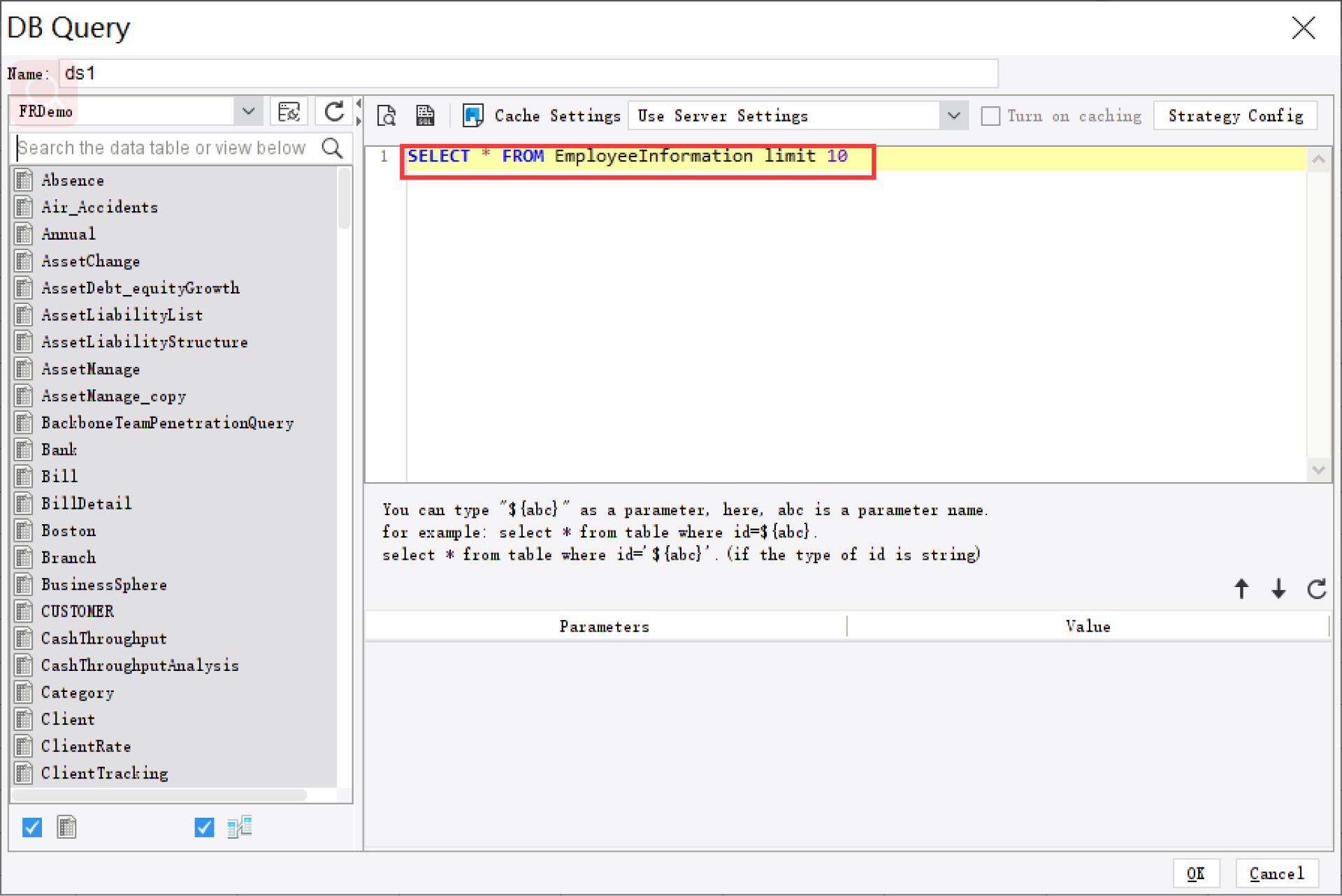
Multi-database and system integration
Exception reporting and drill-down analysis
Pros & Cons:
Pros: Excellent reporting flexibility, strong visibility layer across existing systems, useful for executive and operational views
Cons: Not a transactional SCM platform
Best For (Target user/scenario): Businesses that want better analytics without replacing ERP, WMS, TMS, or procurement software.
Cons: Best results depend on network participation
Best For (Target user/scenario): Enterprises managing complex supplier and logistics ecosystems.
Blue Yonder
One-sentence overview: Blue Yonder combines operational intelligence with planning and fulfillment visibility.
Key Features:
End-to-end visibility tools
Inventory and demand monitoring
AI-guided insights
Performance analytics
Pros & Cons:
Pros: Strong insight depth tied to planning and execution
Cons: May be more than smaller teams need
Best For (Target user/scenario): Companies that want analytics embedded inside a broader optimization platform.
What to look for in supply chain management software services in 2026
The market for supply chain management software services is broader than ever. Some products focus on a single domain, such as procurement or warehouse management, while others aim to serve as end-to-end orchestration platforms. Before shortlisting vendors, teams should define whether they need transactional control, planning intelligence, analytics visibility, or a combination of all three.
Define the core capabilities that separate basic tools from end-to-end platforms
Basic supply chain tools usually solve one operational issue well. That might mean purchase order automation, warehouse slotting, shipment tracking, or inventory counting. End-to-end platforms go further by connecting upstream planning, midstream execution, and downstream analytics inside a unified operating model.
Core capabilities to prioritize include:
Demand forecasting and replenishment planning
Inventory optimization across locations
Procurement and supplier management
Order management and fulfillment workflows
Warehouse and transportation coordination
Real-time dashboards and exception alerts
Cross-functional collaboration for planners, buyers, operations, and finance
If a vendor covers only one or two of these areas, it may still be the right fit, but only if your broader architecture already fills the remaining gaps.
Compare planning, execution, and analytics functions based on business priorities
The best supply chain management software services are not identical for every organization. A manufacturer with variable component lead times may need superior planning. A retailer with high order volume may care more about execution. A multi-site distributor with fragmented systems may need analytics and visibility first.
Use these business-priority questions:
Do we struggle more with forecast accuracy or with order fulfillment?
Is supplier coordination a larger issue than warehouse productivity?
Do executives lack visibility into inventory, service levels, and delays?
Are planners spending too much time reconciling disconnected data?
Do we need one suite, or do we need a stronger analytics layer like FineReport over existing systems?
This framing helps prevent overbuying functionality that looks impressive in demos but adds little operational value.
Identify deployment, integration, and scalability requirements before shortlisting vendors
Deployment model affects speed, cost, and internal support demands. Most modern supply chain management software services are cloud-based, but integration maturity still varies significantly. Teams should look beyond sales claims and confirm how easily the platform connects with ERP, procurement, WMS, TMS, manufacturing, and reporting systems.
Key technical questions include:
Is the platform cloud-native or a modernized legacy product?
How many integrations will require custom middleware?
Can it support growing transaction volume, new regions, and new sites?
Does it handle multi-entity, multi-currency, and multi-language operations?
Can analytics tools like FineReport connect directly to its data outputs?
Scalability should mean more than system performance. It should also mean process adaptability as your supply chain becomes more complex.
Clarify pricing models, implementation effort, and ongoing support expectations
Pricing for supply chain management software services often includes more than license fees. Buyers should account for implementation consulting, data migration, integration, testing, user training, support tiers, and future enhancements.
Clarify the following early:
Subscription vs perpetual or module-based pricing
User-based, transaction-based, or enterprise pricing structures
Typical implementation timeline by company size
Internal staffing requirements during rollout
Post-launch support and service-level agreements
Upgrade, customization, and reporting costs
For many companies, the most expensive mistake is not the software purchase itself but underestimating the time and process redesign needed to make the platform work.
How we compared the 10 platforms
This comparison uses three practical lenses: planning capability, execution workflow depth, and analytics maturity. These categories reflect how most organizations evaluate supply chain platforms in real buying situations.
Evaluation criteria for planning capabilities
Planning assessment focused on how well each platform supports forward-looking decisions rather than just historical reporting.
We looked for:
Demand forecasting quality
Inventory optimization across multiple sites
Scenario modeling and simulation
Sales and operations planning support
Responsiveness to disruptions and re-planning needs
Planning-heavy leaders included Kinaxis, Blue Yonder, SAP, and Oracle.
Evaluation criteria for execution workflows
Execution evaluation emphasized daily operational workflows that move orders, inventory, and materials through the business.
We assessed:
Procurement and purchasing workflows
Order management and allocation
Warehouse coordination
Transportation visibility
Supplier collaboration and operational control
Execution-heavy leaders included Manhattan Associates, Oracle, Infor, and E2open.
Evaluation criteria for analytics and decision support
Analytics and decision support often determine whether teams can actually use supply chain data effectively. A platform may have strong transactions but still leave managers dependent on spreadsheets for reporting.
Reporting flexibility for operational and executive users
FineReport scored strongly in this category because it fills a common gap: turning data from multiple systems into unified, usable reporting for supply chain teams.
Pros, cons, and best-fit use cases for each SCM software solution
Best for small and mid-sized businesses
Small and mid-sized organizations usually need faster implementation, manageable cost, and practical workflow coverage rather than the most expansive feature set.
Epicor SCM
One-sentence overview: Epicor provides balanced supply chain functionality for mid-sized industrial and distribution businesses.
Key Features:
Inventory control
Procurement workflows
Order and warehouse support
ERP-connected operations
Pros & Cons:
Pros: Practical, accessible, strong fit for mid-market operations
Cons: Less sophisticated planning and analytics than some larger suites
Best For (Target user/scenario): Mid-sized manufacturers and distributors.
Infor SCM
One-sentence overview: Infor is a solid fit when industry alignment matters more than having the broadest possible platform.
Key Features:
Demand and operational workflows
Warehouse and logistics support
Industry-specific capabilities
Operational visibility
Pros & Cons:
Pros: Good vertical fit, useful operational coverage
Cons: Product fit depends on deployment context
Best For (Target user/scenario): Growth-stage industrial and distribution businesses.
FineReport
One-sentence overview:FineReport is a cost-effective way for SMB and mid-market teams to improve supply chain visibility without replacing existing systems.
Best For (Target user/scenario): Enterprises that want integrated supply chain and business process modernization.
E2open
One-sentence overview: E2open is especially effective where enterprise complexity extends beyond the company into suppliers and logistics partners.
Key Features:
Multi-enterprise collaboration
Global visibility
Logistics and trade network support
Partner ecosystem connectivity
Pros & Cons:
Pros: Strong network model, valuable for extended supply chains
Cons: Organizational adoption can be challenging
Best For (Target user/scenario): Global companies coordinating large external ecosystems.
Best for modern procurement and supplier collaboration
For some businesses, procurement is the center of supply chain performance. In those cases, sourcing discipline, supplier communication, and spend visibility matter as much as inventory and logistics.
Coupa
One-sentence overview: Coupa is a leading option for procurement-led organizations that want stronger supplier management and spend intelligence.
Pros: Strong procurement governance, good spend transparency
Cons: Less operational depth in warehousing and transportation
Best For (Target user/scenario): Procurement-centric teams aiming to reduce cost leakage and improve supplier decisions.
Oracle
One-sentence overview: Oracle combines procurement with broader supply chain execution, making it useful for teams that want sourcing integrated with operational follow-through.
Key Features:
Procurement and supplier management
Inventory and order linkage
Enterprise approval workflows
Cloud-based controls
Pros & Cons:
Pros: Strong suite integration, broad process continuity
Cons: More extensive than buyers seeking point procurement functionality
Best For (Target user/scenario): Enterprises connecting procurement tightly to finance and operations.
E2open
One-sentence overview: E2open helps procurement teams collaborate across external supply networks where supplier coordination drives resilience.
Key Features:
Supplier collaboration
Partner communication
Visibility across upstream networks
Risk and disruption awareness
Pros & Cons:
Pros: Strong external coordination capabilities
Cons: Success depends on partner connectivity and governance
Best For (Target user/scenario): Businesses with global supplier ecosystems and multi-tier risk exposure.
How to choose the right supply chain management software for your business
The right platform depends less on marketing claims and more on fit. Teams should match software strengths to operational pain points, process maturity, and internal capacity for change.
Match platform strengths to industry requirements, process maturity, and team structure
A discrete manufacturer, a fashion retailer, a food distributor, and a healthcare supplier do not need the same platform emphasis. Industry requirements affect lead times, compliance demands, fulfillment models, and inventory strategy.
Consider:
Industry-specific workflows and regulations
Centralized vs decentralized supply chain teams
Current reliance on spreadsheets and manual reporting
Need for advanced planning vs operational execution
Whether analytics gaps could be solved by FineReport before replacing core systems
In many cases, the best near-term move is not full platform replacement. It may be adding stronger visibility and reporting to existing systems while planning a phased transformation.
Evaluate implementation timelines, data migration risks, and change management needs
Implementation risk is often the deciding factor in supply chain software success. Even strong platforms fail when master data is weak, process ownership is unclear, or end users are not prepared.
Review:
Data quality across suppliers, SKUs, locations, and orders
Integration dependency on ERP, WMS, TMS, and procurement tools
Internal project team bandwidth
User training and process redesign requirements
Rollout strategy by site, region, or function
If reporting is a major problem, deploying FineReport alongside existing systems can provide quick operational transparency while larger platform changes are still underway.
Use a final checklist to compare vendors, request demos, and validate ROI assumptions
Use this final checklist when narrowing options for supply chain management software services:
Does the platform clearly solve our top planning, execution, or analytics issue?
Can it integrate with our ERP, procurement, warehouse, and logistics systems?
Is the implementation scope realistic for our team and budget?
Does the vendor have strong fit in our industry and company size?
Are dashboards and KPI reporting usable by both operations and leadership?
Can we support adoption across planners, buyers, warehouse teams, and managers?
Do we need a full SCM suite, or would an analytics layer like FineReport deliver faster value?
Are ROI assumptions based on measurable outcomes such as forecast accuracy, inventory reduction, faster reporting, lower expedite costs, or better supplier performance?
For companies evaluating supply chain management software services in 2026, the strongest decision is usually the one that aligns platform depth with actual operational need. Enterprise suites like SAP, Oracle, Blue Yonder, and Kinaxis excel when scale and complexity justify major investment. Manhattan, Infor, Epicor, E2open, and Coupa each stand out in specific functional areas. FineReport deserves consideration wherever supply chain teams already have core systems but still lack the dashboards, reporting flexibility, and decision visibility needed to run the business effectively.
FAQs
Supply chain management software helps businesses plan demand, manage inventory, coordinate sourcing, and control logistics across the flow of goods. It gives teams better visibility and faster decision-making from procurement to fulfillment.
Start by matching the platform to your biggest need, such as planning, execution, collaboration, or analytics. You should also evaluate integration with your ERP, WMS, TMS, and finance systems, along with scalability, usability, and implementation effort.
Planning-focused organizations often look at platforms like SAP, Oracle, Blue Yonder, and Kinaxis because they offer forecasting, inventory planning, and what-if modeling. The best fit depends on your industry complexity, response speed requirements, and existing system landscape.
In many cases, yes, especially when native reporting in core SCM systems is limited or fragmented across multiple applications. Tools like FineReport can strengthen dashboards, KPI tracking, and cross-system visibility for better operational decisions.
Cloud platforms usually offer faster updates, easier scalability, and simpler access across distributed teams and partners. On-premises systems may still fit organizations with strict control, compliance, or legacy integration requirements.
Product Trial
FineReport
Pixel-perfect reports · Interactive dashboards · Easy data entry · Digital twins