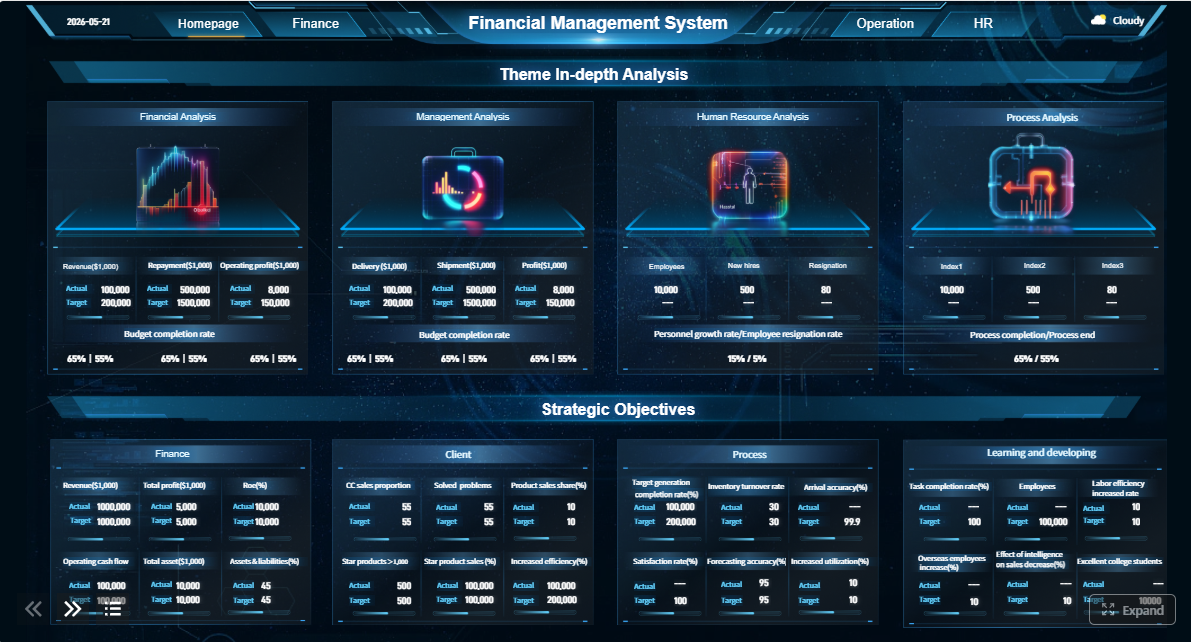
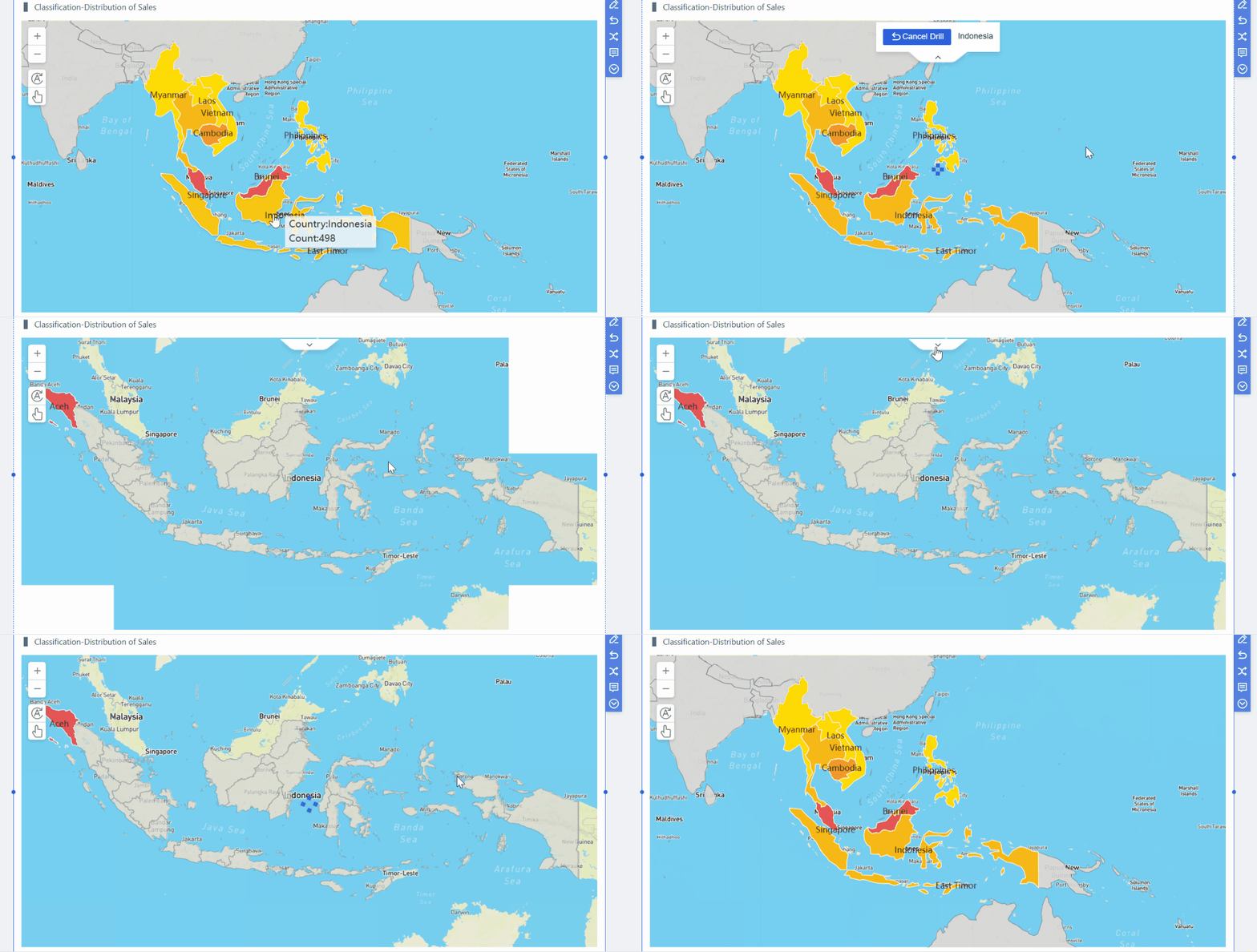
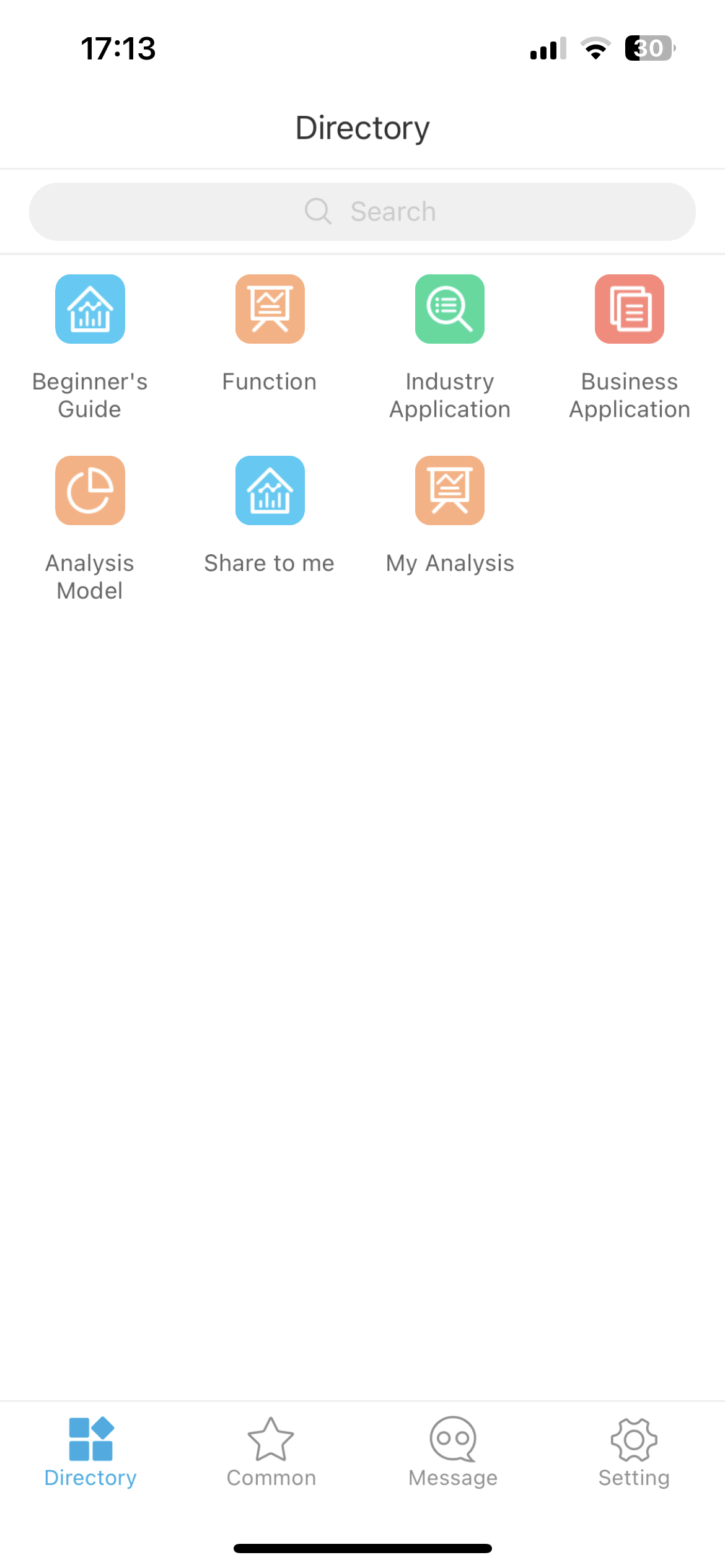
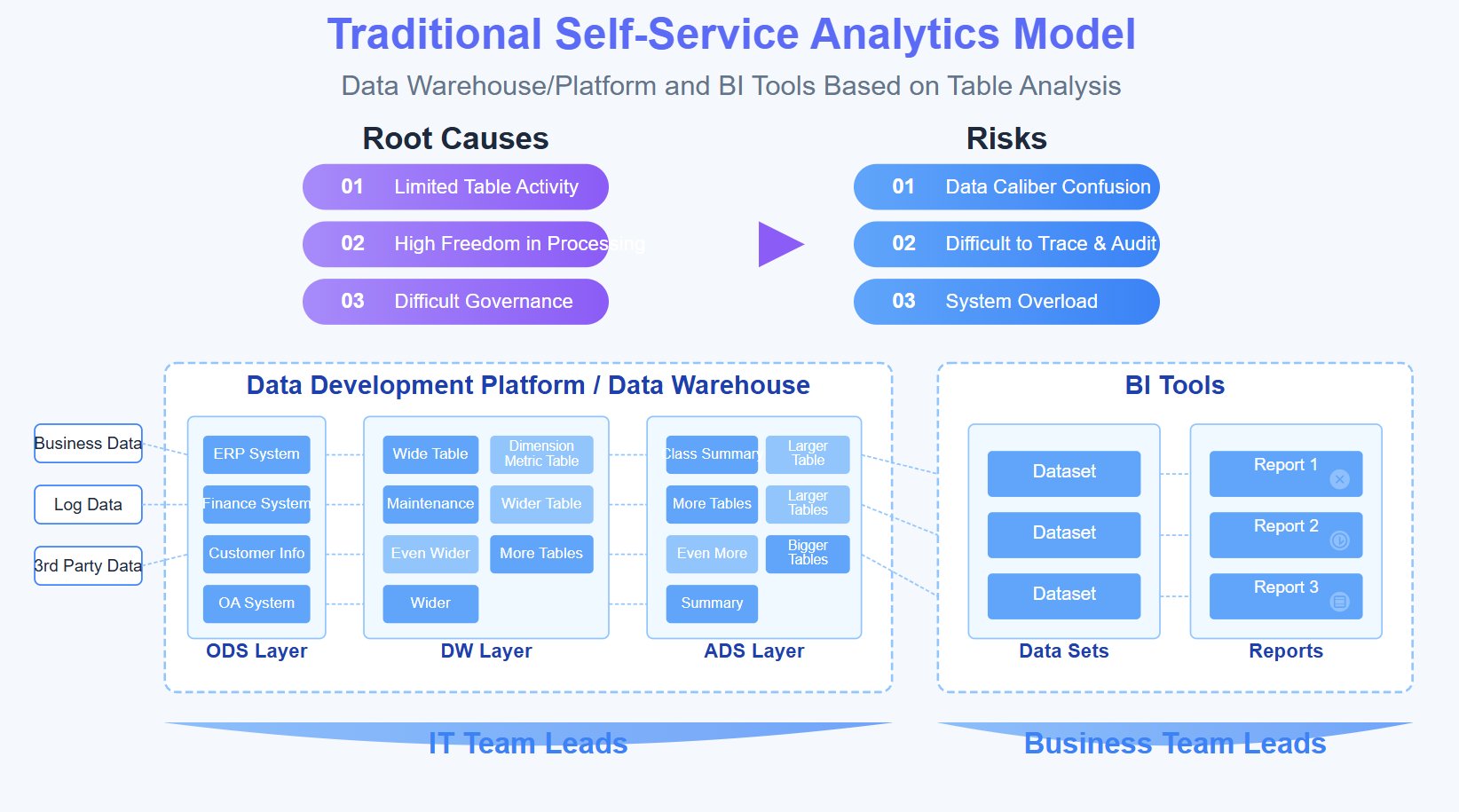
Financial data management becomes a strategic priority when CFOs need to make budget, cash flow, and margin decisions faster than the monthly reporting cycle allows. The problem is rarely a lack of data. It is the lack of a trusted KPI layer that turns raw finance records, operational data, and planning assumptions into decision-ready metrics.
With FineBI + Dora, business users can ask for analysis in chat, generate chart-based answers or dashboard-style views from trusted BI assets, and receive scheduled summaries before the next meeting. That matters for CFOs managing budget pressure, liquidity risk, and profitability swings across multiple systems and teams.
When finance relies on disconnected spreadsheets, inconsistent KPI definitions, and manual reconciliations, every discussion starts with debating the numbers instead of acting on them. A trusted KPI layer changes that. FineBI provides the governed dashboard, metric modeling, and semantic foundation. Dora adds the enterprise Data Agent layer so finance leaders and business stakeholders can retrieve metrics in natural language, receive periodic briefings, monitor exceptions, and follow up on issues faster.
Click To Try The Dashboard
All dashboards in this article are built with FineBI
Why financial data management matters for modern CFOs
For a CFO, financial data management is not just about storing records or producing reports. It is the operating model for turning finance data into reliable business decisions. In practice, that means building a system where budget owners, FP&A teams, controllers, and executives all work from the same KPI logic.
A trusted KPI layer helps leaders answer questions such as:
Are we pacing above or below budget?
Where is cash pressure building this month?
Which products, customers, or business units are compressing margin?
What is causing forecast variance, and who needs to act?
Without that layer, finance teams face three recurring costs.
Fragmented reports slow down decisions
When actuals sit in ERP, pipeline data lives in CRM, payroll is managed elsewhere, and banking or planning data remains offline, finance leaders spend too much time assembling numbers. The result is slower reporting, delayed analysis, and limited confidence during review meetings.
Inconsistent definitions erode trust
If one team calculates gross margin after rebates and another excludes them, the organization does not have a margin metric. It has competing interpretations. The same problem appears in operating cash flow, overdue receivables, forecast accuracy, and budget variance. Once trust breaks, every dashboard becomes negotiable.
Delayed close cycles reduce decision value
A clean month-end close is important, but modern CFOs also need timely operational visibility before close is final. If reporting only becomes usable after significant manual correction, leaders cannot respond fast enough to cost changes, collection issues, or profitability deterioration.
Raw finance data is not the same as business metrics or decision-ready KPIs
This distinction matters:
Raw finance data: transactions, journal entries, invoices, payroll records, bank movements, and source-system data.
Business metrics: processed measures such as revenue, expenses, accounts receivable aging, or budget vs actual.
Decision-ready KPIs: governed, agreed-upon metrics with clear definitions, owners, filters, and business context that executives can act on confidently.
Financial data management is the discipline that moves the organization from raw data to trusted KPIs.
A trusted KPI layer is the structure that makes financial reporting usable across planning, control, and executive decision-making. It is not only a dashboard design issue. It is a combination of metric standardization, governance, data integration, and access control.
Standardized metric definitions
Every critical finance KPI should have documented logic before it is visualized.
Key definition elements include:
metric owner
business purpose
calculation formula
source systems
refresh frequency
time period logic
dimensional breakdowns
exception notes
For CFO teams, this avoids repeated disputes around month-to-date versus booked values, cash definitions, margin treatment, or whether forecasts are weighted, locked, or rolling.
Example KPI structure
Budget Variance: Difference between budgeted and actual spending or revenue for a defined period. Business value: Highlights overrun, underspend, or underperformance quickly. AI use:Dora can retrieve variance by cost center or business unit in chat, summarize the largest drivers, and include the result in scheduled budget briefings.
Operating Cash Flow: Net cash generated from core business operations over a selected period. Business value: Supports liquidity planning and short-term funding decisions. AI use:Dora can compare current cash flow trends with prior periods, flag threshold breaches, and push alerts when collection delays affect projected liquidity.
Gross Margin %:Gross profit divided by revenue, based on agreed treatment of cost of goods sold and adjustments. Business value: Measures pricing health, cost pressure, and profitability quality. AI use:Dora can retrieve margin by product, customer, or channel, generate a chart-based answer, and summarize where margin erosion is occurring.
Forecast Accuracy: Degree to which forecast values align with actual outcomes. Business value: Improves planning discipline and resource allocation. AI use:Dora can produce periodic forecast accuracy summaries and identify the business units with persistent deviation.
DSO (Days Sales Outstanding): Average number of days it takes to collect receivables. Business value: Indicates collection efficiency and working capital pressure. AI use:Dora can monitor DSO changes, explain aging trends, and notify accountable owners when receivable risk worsens.
Data quality and governance controls
Finance reporting only works when quality controls are part of the operating model. That means more than cleansing data once. It requires repeatable governance.
Core controls include:
validation rules for missing or out-of-range values
reconciliation checks between systems
approval workflows for adjustments
audit trails for metric changes
exception handling for unresolved mismatches
role-based ownership for data stewardship
For CFOs, this is especially important in board reporting, cash visibility, and margin reviews. If teams make offline spreadsheet adjustments outside governed workflows, trust disappears quickly.
Integrated reporting foundations
A reliable KPI layer needs connected source systems. Typical finance reporting depends on more than the general ledger.
Important sources often include:
ERP for actuals and accounting records
CRM for bookings, pipeline, and customer-level revenue context
payroll and HR systems for labor cost visibility
banking data for liquidity and cash movements
planning systems for budget and forecast data
procurement or operations systems for cost drivers
FineBI helps unify these assets into dashboards, metric models, and trusted semantic definitions. This creates a reusable base for both human analysis and Dora’s governed AI workflows.
Strong financial data management combines technical integration, quality discipline, and controlled access. CFOs do not need a theoretical data platform. They need a decision system that works across daily operations, periodic review, and executive reporting.
Data collection and consolidation
The first requirement is to consolidate actuals, budgets, forecasts, and operational drivers into one analysis-ready environment.
That often includes:
general ledger actuals
budget versions
rolling forecasts
sales and demand signals
headcount and payroll drivers
procurement and inventory costs
receivable and payable positions
banking balances and movements
This matters because finance decisions rarely rely on a single source. Budget reallocation may depend on revenue trajectory, labor cost trends, and margin by product line at the same time.
Are required records, dimensions, and supporting attributes present? Missing product, customer, or department tags reduce analysis quality immediately.
Accuracy
Do figures align with source records and accounting logic? Accuracy checks should cover mapping, calculation, and reconciliation.
Consistency
Are the same entities and KPIs defined the same way across systems and reports? This is essential for board packs and cross-functional reviews.
Timeliness
Is the data refreshed in time for decisions? Finance teams often need scheduled or near real-time monitoring for liquidity and receivables, even if formal close remains periodic.
Reconciliation
Do reports tie back to governed source values? Reconciliation is critical when CFOs use dashboards to support planning, investor discussions, or operational interventions.
Security, compliance, and access control
Finance data is sensitive by default. Access design must protect confidentiality without blocking useful analysis.
role-based permissions by entity, region, or function
segregation of sensitive payroll or compensation data
governed access to bank and liquidity views
audit visibility for data changes and report usage
controlled sharing for board, executive, and operational audiences
This is where enterprise BI matters. FineBI supports governed access boundaries, and Dora should operate within those boundaries so AI outputs respect permissions, semantic rules, and data governance.
A trusted KPI layer is best built in phases. The goal is not to model every finance metric on day one. The goal is to stabilize the highest-value decisions first.
Start with decision-critical use cases
Begin where finance friction is highest and business value is easiest to prove.
Common starting points for CFOs include:
budget vs actual monitoring
rolling forecast review
weekly cash visibility
receivables and payables risk tracking
margin by product, customer, or business unit
executive and board reporting
This focus prevents teams from overbuilding low-value dashboards before the core KPIs are trusted.
Align teams around one source of truth
Finance cannot define critical KPIs in isolation if the business uses different operational logic. CFOs should bring together finance, operations, sales, and business-unit leaders to agree on shared definitions.
That alignment should cover:
metric formulas
time calendars
target logic
source hierarchy
adjustment rules
ownership and approval
The outcome is a semantic layer the organization can actually use. FineBI turns this into governed metric assets, while Dora can then interpret user questions using the right business terms and KPI definitions.
Automate refresh and review cycles
Manual spreadsheet circulation creates delay and version confusion. Once core KPIs are defined, finance should automate refresh and review routines as much as practical.
Examples include:
scheduled dashboard refreshes
weekly budget variance summaries
cash threshold alerts
margin exception monitoring
periodic management briefing pushes
This is where AI creates operating leverage. Instead of waiting for analysts to prepare every summary, Dora can help deliver scheduled briefings, chart-based answers, and follow-up notifications based on trusted FineBI assets.
Measure adoption and business impact
A KPI layer is only valuable if it changes decision quality and execution speed. CFOs should track both usage and outcome.
Practical applications for budget, cash flow, and margin decisions
The real test of financial data management is whether it improves specific decisions. For CFOs, three use cases usually deliver the fastest value.
Budgeting and scenario planning
Budgeting breaks down when teams use inconsistent assumptions or outdated actuals. A trusted KPI layer gives finance and business leaders a common set of baseline metrics.
That enables teams to:
compare actuals vs plan using the same definitions
test multiple forecast scenarios with consistent inputs
identify over- or under-funded functions quickly
reallocate resources based on changing priorities
prepare management reviews with fewer data disputes
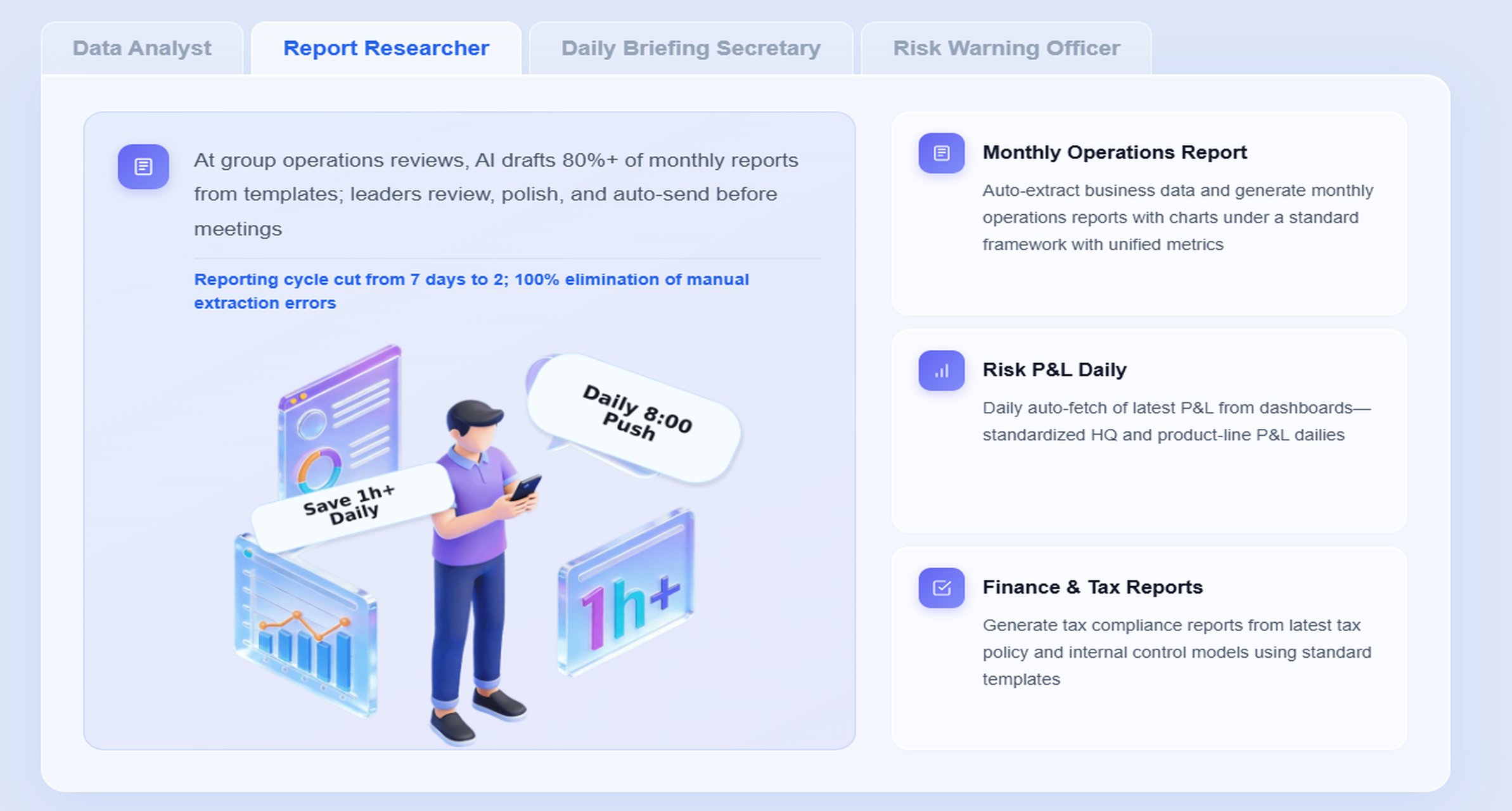
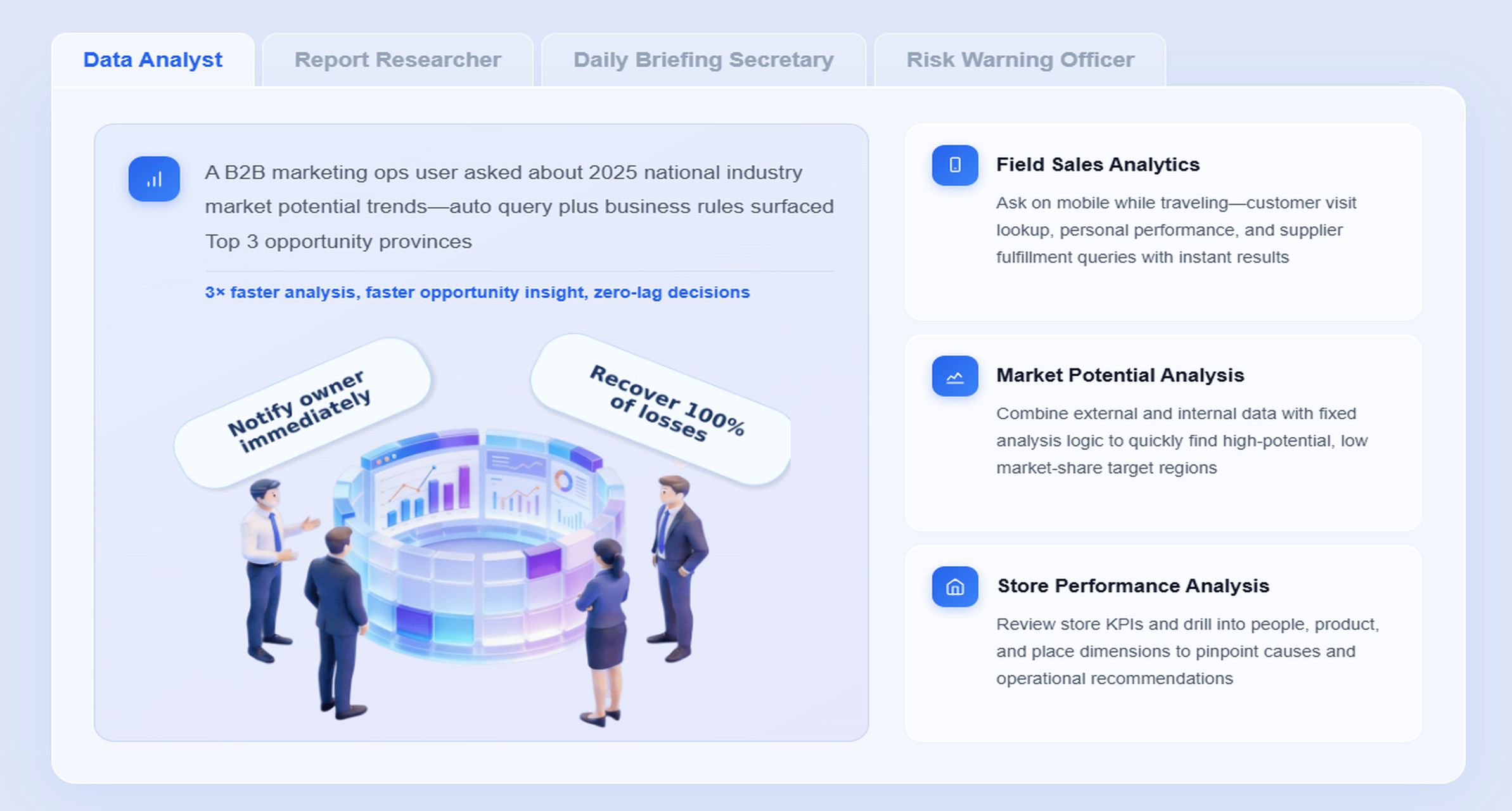
In FineBI, finance can build governed budget and scenario dashboards with trend, variance, and drill-down views. Dora can then act as a Data Analystdigital employee or Report Researcher to retrieve those views in chat and generate concise summary narratives for review meetings.
Cash flow monitoring and working capital
Cash visibility is one of the clearest examples of why financial data management must go beyond static reporting. CFOs need timely, reliable insight into collections, payables, liquidity risk, and short-term funding needs.
A trusted KPI layer can support:
operating cash flow monitoring
cash balance tracking by entity or bank
receivables aging and DSO review
payable timing analysis
liquidity risk and covenant watchlists
With FineBI, finance teams can create dashboards that combine ERP, banking, and receivables data into one governed view. Dora can support periodic briefings, threshold monitoring, and owner follow-up when overdue collections or cash pressure indicators exceed agreed rules.
Margin analysis and profitability management
Margin discussions often collapse into argument because product, customer, and channel profitability are measured differently across teams. Financial data management brings discipline to those calculations.
A strong margin view helps CFOs:
compare gross margin and contribution trends consistently
identify cost inflation impact by product line
understand discounting and mix effects
isolate low-profit customers or channels
support pricing and portfolio decisions
FineBI can model governed margin metrics and present dashboard-style analysis views across products, regions, or business units. Dora can then help executives ask for quick comparisons in natural language without manually searching multiple reports.
For CFO scenarios, the most relevant Dora digital employees are usually the Daily Briefing Secretary, Data Analystdigital employee, and Risk Alert Officer. Together, they help finance teams move from passive dashboards to governed AI workflows that retrieve, explain, monitor, and push insights based on trusted KPI assets.
Dora works best when FineBI has already established the trusted BI foundation: dashboards, semantic definitions, governed metrics, access rules, and analysis subjects. Dora does not replace that foundation. It activates it through chat, summaries, alerts, and follow-up.
A scenario-specific chat example
A CFO or FP&A leader might ask:
“Show me this month’s budget variance, operating cash flow trend, and gross margin by business unit. Highlight the biggest risks and prepare a short briefing for tomorrow’s finance review.”
Dora can interpret the request using the governed KPI layer in FineBI, retrieve the relevant dashboard or metric assets, and return a chart-based answer or dashboard-style analysis view with a concise summary.
Dora workflow for financial data management
Retrieve trusted FineBI assets Dora accesses the relevant FineBI dashboard, metric model, or analysis subject for budget variance, cash flow, and margin.
Understand KPI definitions and business rules
It uses the semantic layer to interpret terms such as operating cash flow, gross margin, variance thresholds, fiscal period logic, and business-unit mappings.
Generate chart-based answers in chat Dora returns the requested analysis as a chart, table, dashboard-style analysis view, or summary instead of a raw text-only answer.
Detect anomalies or threshold breaches
If cash flow drops below a defined threshold or one business unit shows unusual margin compression, Dora can flag the issue based on governed rules.
Push insights to responsible users
The Daily Briefing Secretary can send scheduled summaries before meetings, while the Risk Alert Officer can notify finance owners or business-unit leaders about cash or margin exceptions.
Produce follow-up outputs for management review Dora can prepare a structured briefing summary, meeting notes draft, or issue list for CFO review, using trusted FineBI data as the source.
Why this works in real enterprises
The value here is not a flashy AI demo. It is controlled execution.
Dora is an enterprise Data Agent platform designed for governed AI workflow execution. That means:
natural-language data query runs against trusted BI assets
KPI definitions come from the FineBI semantic foundation
permissions and access boundaries are preserved
reusable Skills improve control and auditability
scheduled pushes and alerts support repeatable finance workflows
This is why FineBI + Dora lands better than prompt-only agent experiments. Finance teams need reliable KPI context, not free-form guessing. FineBI provides the trusted dashboard and metric foundation. Dora adds the AI assistant layer that can answer in chat, summarize trends, monitor risk conditions, and follow up with the right owners.
For business users, Dora reduces the friction of finding and interpreting data. Instead of searching through multiple dashboards, a CFO, controller, or FP&A manager can ask for a specific analysis and get a governed answer quickly.
For IT and data teams, the shift is also meaningful. They spend less time manually rebuilding every report request and more time optimizing data connections, KPI governance, permissions, semantic setup, and reusable agent Skills.
For executives, the result is concrete: Dora is not an AI experiment. It is a landed digital employee for recurring finance work such as weekly cash briefing, budget variance review, monthly margin summary, and risk follow-up on overdue receivables.
Most financial data management problems are not caused by missing tools alone. They come from poor KPI discipline, uncontrolled adjustments, and trying to automate before governance is ready.
Avoid overengineering dashboards before agreeing on KPI definitions
If teams build executive dashboards before standardizing metric logic, they simply scale disagreement. Define critical KPIs first, then visualize them.
Prevent duplicate metrics and offline spreadsheet adjustments
A KPI layer loses trust when different teams maintain separate versions of revenue, margin, or cash metrics. Limit unofficial metric copies and route changes through governed workflows.
Apply a phased rollout with clear ownership
Start with a manageable set of high-value use cases such as budget variance, cash monitoring, and margin review. Assign business owners, data stewards, and approval rules for each KPI.
Best practices for implementation
Standardize KPI definitions, synonyms, filters, and ownership
This improves both dashboard trust and Dora’s ability to understand natural-language requests accurately.
Build the semantic layer inside the BI workflow FineBI should hold the governed metric logic, dimensions, and business terminology that both analysts and Dora can reuse.
Treat data quality as part of the AI implementation Dora can only deliver reliable finance answers when source data, KPI logic, and reconciliation controls are sound.
Start with recurring, high-value finance workflows
Use Dora first for repeatable processes such as daily cash summaries, budget variance briefings, or margin exception alerts instead of trying to automate everything.
Preserve permission governance and use human review
AI-generated summaries and reports should respect FineBI access controls, and important finance outputs should be reviewed by accountable owners before broader distribution.
Building this manually is complex. FineBI helps teams build trusted dashboards, metrics, and semantic assets. Dora turns those assets into an AI assistant that can answer questions in chat, generate dashboard-style analysis views, push scheduled summaries, monitor anomalies, and follow up with responsible owners.
For financial data management, this combination is especially practical. Finance teams need a governed KPI layer for budget, cash flow, and margin decisions. FineBI provides that trusted BI foundation through dashboarding, self-service analytics, metric modeling, and reusable semantic assets. Dora extends that foundation with enterprise Data Agent capabilities so users can ask finance questions in natural language, retrieve governed answers, receive timely briefings, and act faster on exceptions.
FineBI + Dora is not only a BI upgrade; it is a practical fourth-generation Agentic BI path. FineBI provides governed metrics and visual analysis. Dora provides the AI assistant layer for scenario execution, with more controlled Skills, lower token waste, faster execution paths, and more stable workflows than prompt-only agents.
Get Ready-to-Use Dashboard Templates in Fine Gallery
The strongest Dora pitch is scenario + product + service: FineBI provides the trusted BI foundation, Dora provides the AI digital employee, and implementation service connects data, governance, semantic setup, Skills, and rollout.
governed dashboards for budget, cash flow, and margin analysis
chat-based access to trusted BI assets
scheduled briefings for leadership review
anomaly alerts and owner follow-up for finance risks
stronger enterprise fit through permissions, semantic rules, KPI governance, and data quality
If your finance team wants faster decisions without sacrificing trust, start by building the KPI layer correctly. Then add the AI assistant layer that helps the organization use it every day.
Financial data management is the process of turning raw finance and operational data into accurate, usable information for decisions. For CFOs, it matters most when it creates a trusted KPI layer for budget, cash flow, margin, and forecast analysis.
A trusted KPI layer gives every team the same metric definitions, business logic, and reporting context. This reduces time spent debating numbers and helps leaders act faster on budget gaps, liquidity risk, and margin changes.
Raw financial data includes transactions, invoices, payroll records, and bank movements from source systems. A KPI is a governed metric with agreed calculations, owners, filters, and business meaning that executives can use confidently.
A strong KPI definition should include the metric owner, purpose, formula, source systems, refresh timing, and dimensional breakdowns. It should also clarify period logic and any exception rules so reporting stays consistent across teams.
FineBI provides governed dashboards, metric modeling, and a semantic layer for trusted reporting. Dora adds natural language access, scheduled summaries, and faster follow-up on exceptions so finance teams can move from reporting to action more quickly.
Product Trial
FineReport
Pixel-perfect reports · Interactive dashboards · Easy data entry · Digital twins