Enterprise performance management is no longer just about producing monthly packs and monitoring dashboards. For CFOs, it is about turning strategy, planning, reporting, and review cycles into a disciplined decision system. And that system now needs an AI assistant upgrade.
With FineBI + Dora, business users can ask for analysis in chat, generate chart-based answers or dashboard-style views from trusted BI assets, and receive scheduled summaries before the next meeting. That matters because finance leaders are under pressure to review performance more frequently, explain drivers faster, and turn discussions into accountable follow-up.
Click To Try The Dashboard
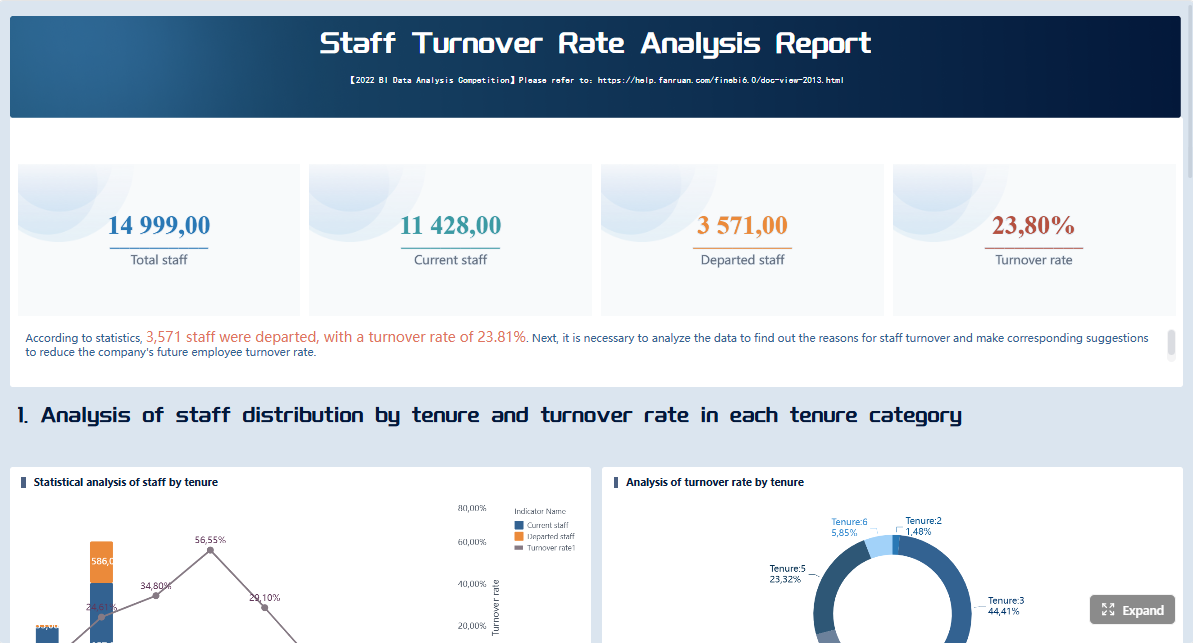
All dashboards in this article are built with FineBI
In plain terms, enterprise performance management is the management framework an organization uses to connect strategy with execution. It helps leaders set targets, plan resources, track results, explain gaps, and decide what to do next.
For a CFO, that means enterprise performance management is not a single report or software screen. It is the operating discipline that links:
A useful way to think about it is this: ERP records what happened in the business. Enterprise performance management helps leadership interpret what the numbers mean, decide whether the business is on track, and determine how to respond.
This is why enterprise performance management differs from isolated dashboards, static KPI packs, and backward-looking monthly reviews.
Isolated dashboards often show metrics without consistent context, ownership, or action logic.
Static KPI packs summarize results but can be too slow, too manual, and too disconnected from operational drivers.
Backward-looking monthly reviews explain the past but may not support timely course correction.
A modern CFO needs more than visibility. They need a review process that can identify issues earlier, summarize likely drivers, and prepare decision-ready discussions across finance and operations.
That is why finance leaders are revisiting enterprise performance management now. Data volumes are larger, business models are more complex, and review frequency is increasing. Weekly and even daily monitoring is becoming important in areas like revenue execution, cost control, working capital, supply risk, and margin protection. Traditional review processes struggle to keep up.
Each element matters on its own, but the value of enterprise performance management comes from how they work together.
Planning
Planning translates strategy into targets, assumptions, and resource allocation. It answers where the business is trying to go and what it will take to get there.
Budgeting
Budgeting formalizes financial expectations and accountabilities. It provides guardrails for spend, investment, and performance targets.
Forecasting
Forecasting updates the outlook based on current conditions. It is especially important for CFOs because it shifts finance from historical reporting to forward-looking decision support.
Consolidation
Consolidation brings results together across entities, functions, and business units. Without this, enterprise-wide performance reviews become fragmented and slow.
Management reporting
Management reporting turns raw results into usable visibility for leadership. This includes KPI tracking, variances, trends, commentary, and exception views.
Scenario analysis
Scenario analysis allows finance and business leaders to test possible outcomes. This is essential when assumptions change and leadership needs to understand downside, upside, and operational trade-offs.
Performance review cycles
Review cycles create the cadence for discussion, accountability, and action. A monthly deck alone is not a performance management process. The process needs recurring meetings, owner follow-up, and decision tracking.
A strong enterprise performance management model also depends on common metrics, clear ownership, and governance.
Here is what that looks like in practice:
one agreed definition of revenue, margin, operating expense, cash conversion, and other key metrics
documented owners for each KPI
standard filters and hierarchies across business units
governed access to financial and operational views
a repeatable review workflow
Without this discipline, enterprise performance management turns into endless debates about whose number is correct.
Scope beyond finance alone
Although finance usually sponsors enterprise performance management, it does not belong to finance alone.
Sales leaders contribute pipeline, bookings, win rate, and account risk inputs. Operations leaders provide production, fulfillment, service level, and efficiency metrics. HR leaders contribute workforce costs, headcount, attrition, and capacity indicators. Business unit leaders provide context on local performance drivers and execution risks.
That cross-functional participation is what makes enterprise performance management useful. It supports both:
operational execution, such as addressing margin leakage, delivery bottlenecks, or underperforming regions
strategic priorities, such as growth, efficiency, resilience, and capital allocation
For CFOs, the key is to build a review model where finance provides the trusted framework, while the business contributes real operating context.
Why dashboards alone are no longer enough for CFOs
Limits of dashboard-led performance review
Dashboards are valuable. They help leaders see trends, compare periods, and explore breakdowns. FineBI plays this foundational role extremely well by providing trusted dashboards, self-service analytics, metric modeling, and semantic assets.
But dashboards alone are often not enough for CFO-level performance management.
Common limitations include:
fragmented data across finance, sales, and operations
lagging indicators with limited explanation of underlying drivers
too much time spent interpreting conflicting numbers
weak accountability after review meetings
manual effort to prepare commentary and follow-up
no consistent path from metric visibility to next action
In many organizations, the dashboard shows what happened, but the CFO still has to ask:
Why did this happen?
Which business units are driving the change?
Is this temporary or structural?
Who owns the issue?
What follow-up should happen before the next review?
That gap between visibility and execution is where enterprise performance management often breaks down. Teams spend too much time assembling numbers and not enough time making decisions.
Moving toward AI-assisted reviews
AI-assisted reviews help close that gap when they are built on trusted metrics and governed workflows.
In a finance context, AI can help by:
surfacing anomalies before the meeting
summarizing key drivers behind KPI changes
identifying notable breakdowns by region, product, entity, or customer segment
suggesting follow-up questions for leadership review
generating scheduled briefing summaries
pushing exceptions or alerts to responsible owners
helping teams retrieve the right dashboard or chart through natural-language query
This does not remove the need for human judgment. CFOs still decide priorities, evaluate trade-offs, and interpret business context. Finance leaders still need to challenge assumptions, assess risk, and make calls that depend on strategy and governance.
What AI changes is the speed and consistency of the preparation layer. Instead of manually pulling screenshots, reconciling multiple files, and drafting the same summary every week, teams can use an enterprise Data Agent to accelerate recurring review work.
That is the practical upgrade path from dashboards to AI-assisted reviews: keep the trusted BI foundation, then add an AI assistant layer that makes reviews faster, more consistent, and more actionable.
How an effective enterprise performance management process works
From data collection to review actions
An effective enterprise performance management process follows a clear sequence from trusted data to management action.
1. Collect trusted data inputs
The process starts with governed data from finance systems, operational platforms, and business applications. This may include ERP, CRM, planning systems, HR systems, and operational tools.
2. Standardize metrics and business definitions
Before analysis is useful, the organization needs aligned KPI definitions, time logic, hierarchy structures, and business terminology. This is where FineBI’s metric modeling and semantic assets become important. They help ensure that the same KPI means the same thing across users and departments.
3. Analyze performance and explain variance
Teams review actuals versus budget, forecast, prior period, and target. They look at trend changes, breakdowns, and exception areas to understand what is driving results.
4. Run review meetings with a decision focus
Performance reviews should not become presentation sessions. They should center on a small set of business-critical issues, the drivers behind them, and the decisions needed.
5. Assign actions and owners
Every meaningful review should end with next steps, owners, deadlines, and escalation logic where appropriate.
6. Track follow-up and course correction
Action tracking matters as much as KPI tracking. Without follow-up, enterprise performance management becomes a reporting ritual instead of a management process.
The quality of this flow depends on three things:
standardized definitions
workflow discipline
timely updates
If metrics are inconsistent, review discussions become unproductive. If workflow discipline is weak, action items disappear. If updates are too slow, the business reacts after the opportunity or risk has already passed.
The CFO's role in making EPM useful
The CFO is often the executive sponsor who makes enterprise performance management effective across the organization.
That role includes:
setting the review cadence
aligning finance and business leaders on priority metrics
insisting on common definitions and one version of KPI logic
focusing discussions on performance drivers, not just totals
requiring review meetings to end with actions and owners
using forecasts and scenarios to support decisions, not just compliance
A strong CFO also shapes the tone of the process. The goal is not to create more reporting overhead. The goal is to create better performance conversations.
That is why the shift from dashboards to AI-assisted reviews is relevant for finance leaders. It is not about novelty. It is about making recurring review work more decision-ready.
Core framework and key metrics for CFO-led enterprise performance management
For most CFOs, enterprise performance management becomes practical when a small set of core KPIs is governed consistently across planning, reporting, and review.
Financial and operational KPIs that matter most
Revenue growth: Change in revenue over time by business unit, product, geography, or channel. Business value: Shows growth trajectory and market execution quality. AI use:Dora can retrieve the latest revenue trend through chat, compare actuals to budget or forecast, and summarize the main growth or shortfall drivers before a review meeting.
Gross margin: Revenue minus direct cost as a percentage or absolute value. Business value: Indicates pricing quality, cost control, and product mix performance. AI use:Dora can highlight margin compression, identify the product or region breakdown most responsible, and include it in a scheduled finance briefing.
Operating expense variance: Difference between actual operating expense and budget or forecast. Business value: Helps finance control spend discipline and detect emerging cost pressure. AI use:Dora can answer natural-language questions such as which functions are over budget and generate a chart-based answer from FineBI assets.
EBITDA or operating profit: Earnings generated after operating costs, depending on the company’s reporting model. Business value: Connects top-line performance and cost control to profitability. AI use:Dora can summarize whether profit changes are driven more by revenue volume, mix, pricing, or expense movement.
Cash conversion cycle: Time required to convert investment in operations into cash. Business value: Helps CFOs monitor liquidity efficiency and working capital quality. AI use:Dora can detect deterioration in receivables, payables, or inventory days and push exception summaries to responsible owners.
Forecast accuracy: Degree to which forecasted figures match actual outcomes. Business value: Measures whether forecasts are decision-ready or merely procedural. AI use:Dora can compare historical forecast versions with actuals and prepare a briefing on recurring forecast bias.
Budget attainment: Degree to which a team or business unit is meeting approved targets. Business value: Supports accountability and resource allocation discipline. AI use:Dora can provide a dashboard-style analysis view ranking units by target achievement and flag outliers.
Working capital metrics: Indicators such as DSO, DPO, inventory days, or net working capital ratio. Business value: Critical for liquidity management, balance sheet quality, and operational resilience. AI use:Dora can monitor thresholds, detect unusual changes, and support the Risk Alert Officer workflow for timely escalation.
Why KPI governance matters
These metrics only work in enterprise performance management when they are governed properly. That means:
one definition per KPI
approved business terms and synonyms
clear ownership
documented drill paths
permissions aligned with role and data sensitivity
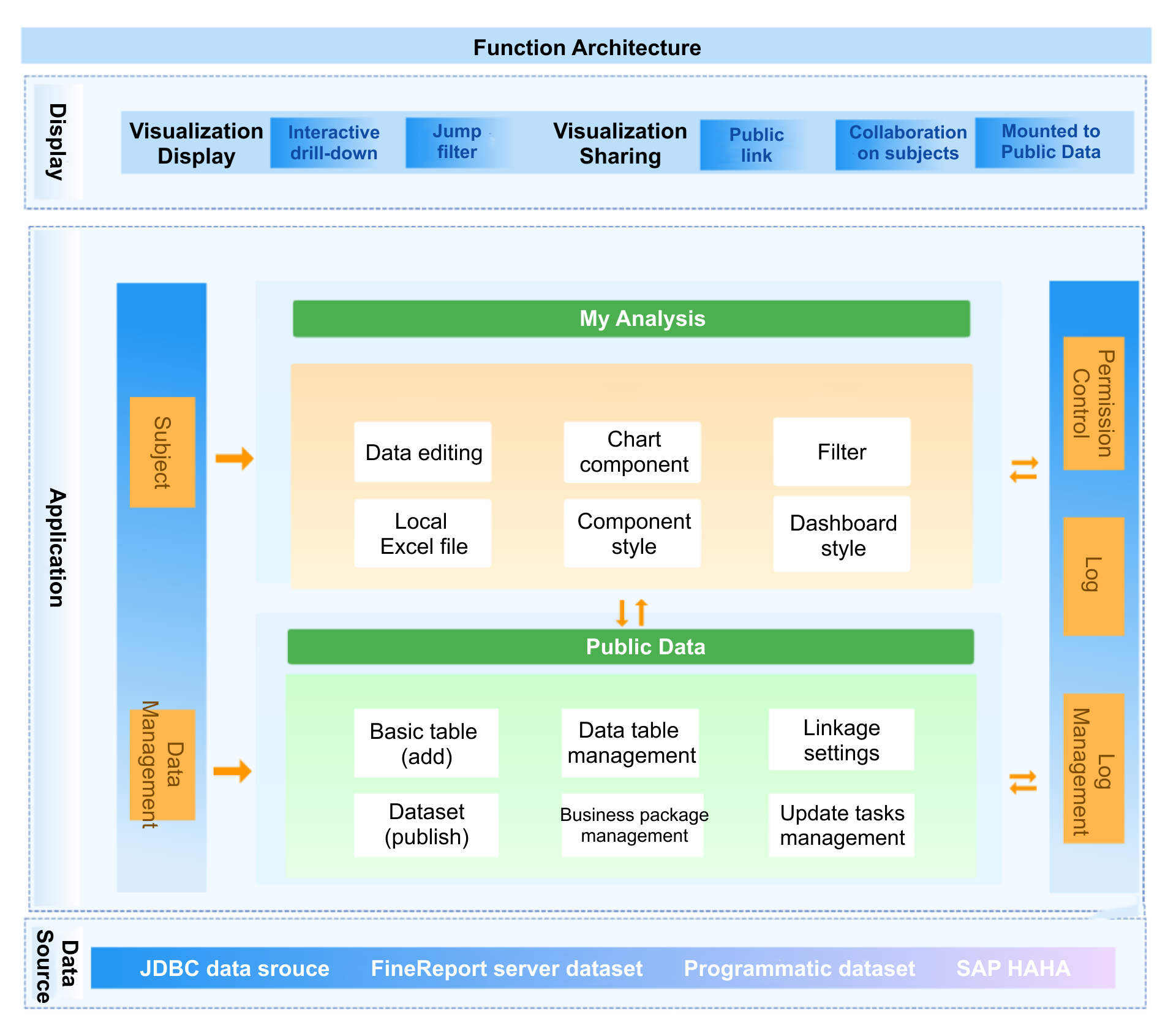
This is where FineBI is the foundation. It provides the trusted dashboards, governed metrics, semantic rules, and visual analysis environment. Then Dora turns that trusted foundation into a scenario-specific AI assistant that can retrieve, explain, summarize, push, and follow up on performance insights.
How an AI Data Agent Handles This Scenario
For CFO-led enterprise performance management, the most relevant Doradigital employee is often the Daily Briefing Secretary, supported by the Data Analyst and Risk Alert Officer when deeper review or exception monitoring is needed.
Dora is not a generic chatbot. It is an enterprise Data Agent layer that works on top of trusted BI assets and governed workflows. In this scenario, Dora helps finance teams move from manually preparing review packs to using AI-assisted, repeatable, controlled review support.
“Show me this month’s enterprise performance management summary: revenue, gross margin, opex variance, and cash conversion by business unit. Highlight major risks, compare to budget and forecast, and prepare a short briefing for tomorrow’s performance review.”
Instead of sending analysts into multiple systems and spreadsheets, Dora can use trusted FineBI assets to return a chart-based answer, a dashboard-style analysis view, and a summary of key changes.
How the AI workflow works
Retrieve trusted FineBI dashboard or analysis-subject data Dora accesses the governed FineBI dashboards, metric models, and semantic assets relevant to finance review.
Understand KPI definitions, filters, business terms, and semantic rules Dora uses approved business logic such as what counts as operating expense variance, which hierarchy defines business unit, and which period comparison should apply.
Generate chart-based answers and summary analysis through chat Dora returns the requested metrics, trend views, breakdown charts, and a concise narrative for the CFO or finance manager.
Detect abnormalities or threshold breaches
If margin falls below threshold, forecast variance spikes, or working capital worsens beyond policy tolerance, Dora can identify exceptions for review.
Push insights and alerts to responsible users Dora can send scheduled summaries, periodic briefings, or exception notifications to finance leaders and operational owners.
Produce follow-up summaries for meetings and management review
After the review cycle, Dora can help package action-focused summaries for executives, finance teams, or business unit owners.
The relevant Dora digital employee in this scenario
Daily Briefing Secretary
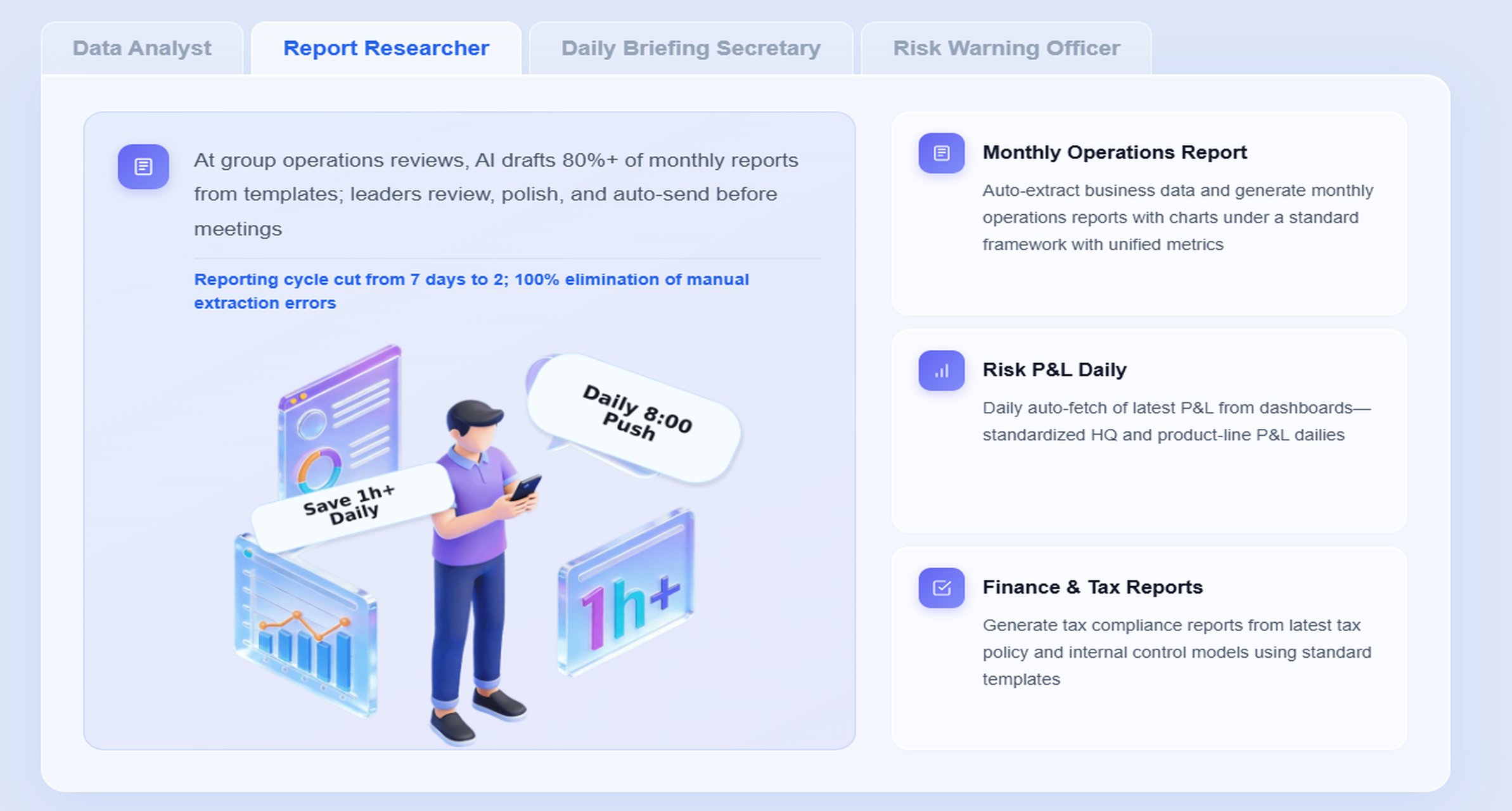
This role is ideal for recurring management reviews. It can prepare daily, weekly, or monthly performance summaries using FineBI metrics and dashboards.
Typical use cases include:
CFO morning briefings
month-end performance summaries
forecast review prep
executive KPI updates
board or management meeting pre-read support
Data Analyst digital employee
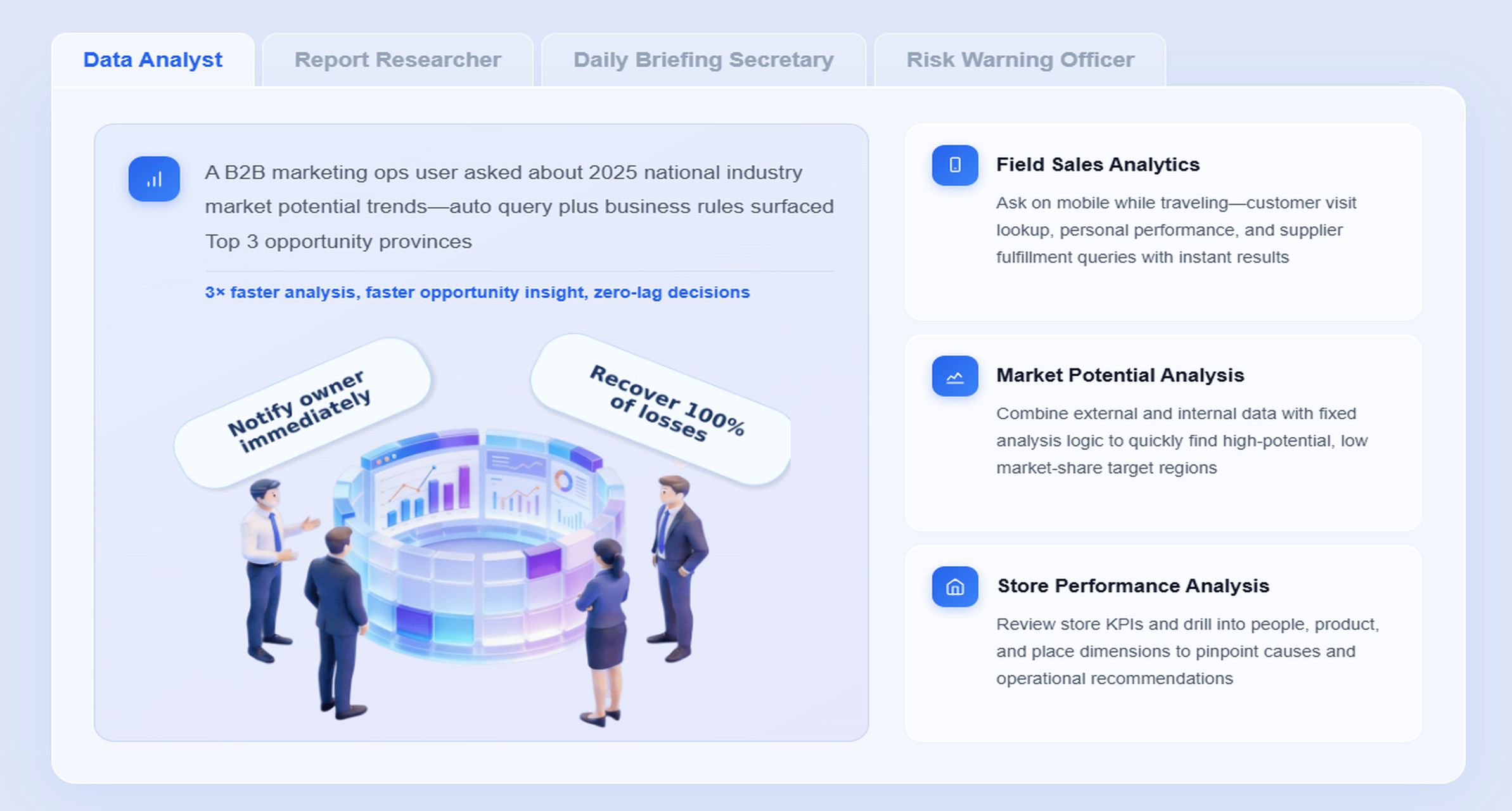
This role supports natural-language analysis and follow-up questions. It is useful when finance leaders want to drill into a variance or ask for additional breakdowns during a review.
Examples:
“Break down margin decline by product family.”
“Compare this quarter’s opex overspend by function and entity.”
“Show the top drivers behind forecast miss in APAC.”
Risk Alert Officer
This role helps monitor threshold breaches and exceptions. It is useful for working capital risk, overspend alerts, declining forecast confidence, or major KPI anomalies.
Why FineBI matters to AI accuracy and enterprise fit
AI-assisted enterprise performance management only works well when the underlying metrics are trusted.
That foundation matters because Dora needs trusted KPI definitions, business terms, and governed data access to produce useful finance outputs. Without that, AI may return inconsistent answers or amplify existing metric confusion.
How Dora improves execution, not just retrieval
The real value of Dora is not only that it can answer a question in chat. It helps improve execution across the review process.
It can support:
chat-based metric retrieval for finance and business users
scheduled summaries before recurring meetings
chart-based answers instead of plain text responses
skills-based execution for more controllable and auditable AI workflows
This matters in enterprise settings because prompt-only agents often struggle with consistency, permissions, and governance. Dora’s governed AI workflow approach is better suited to recurring finance processes. It is designed for stronger enterprise fit through permissions, semantic rules, KPI governance, and data quality. It also offers better landing capability than feature-only agent comparisons because it is tied to real BI assets and repeatable business scenarios.
For CFOs, that makes Dora less of an AI experiment and more of a practical AI digital employee for recurring data work such as review briefing, variance explanation, risk alerting, and owner follow-up.
Can users retrieve the same KPI consistently across dashboards and reports?
Are permissions and data boundaries respected across functions?
AI readiness
Are KPI definitions, synonyms, and semantic rules documented well enough for AI use?
Do you have recurring review workflows that are suitable for a digital employee?
Can the business accept AI-generated summaries with human review and governance?
If the answer to many of these questions is no, then the challenge is not just tooling. It is the design of the enterprise performance management process itself.
Practical next steps for modernization
Most organizations should not try to modernize everything at once. The better path is to start with one high-value review process and improve it step by step.
1. Start with a high-value recurring review workflow
Choose a finance process with clear business impact, such as:
monthly enterprise performance review
weekly sales and margin review
working capital exception review
forecast update meeting
This creates a realistic landing point for both BI and AI adoption.
2. Clean up metric definitions and ownership
Before adding AI, standardize KPI definitions, business synonyms, filters, and metric ownership. This is essential for trusted dashboard use and for Dora to answer correctly in chat.
3. Connect planning with reporting
A strong enterprise performance management model connects budget, forecast, actuals, and review outputs. If planning and reporting are disconnected, review quality suffers.
4. Pilot AI-assisted insights in a controlled workflow
Introduce Dora in one scenario first, such as CFO briefing preparation or variance review support. Use governed FineBI assets and human review of outputs. Then expand to additional Skills and workflows.
5. Build change management into the rollout
Adoption matters as much as technology. Users need to know when to trust the system, when to challenge outputs, and how AI fits into their review process.
1. Standardize KPI definitions before expanding reporting
Do not scale dashboards or AI workflows on top of ambiguous metrics. Standardize definitions, hierarchies, synonyms, and calculation logic first. This improves both human review quality and AI answer quality.
2. Build a semantic layer inside the BI workflow
FineBI should act as the governed metric and semantic foundation. This makes enterprise performance management more reliable because both dashboards and Dora are working from the same definitions and business language.
3. Treat data quality as part of AI implementation
AI-assisted reviews are only as strong as the underlying data. Missing mappings, timing gaps, broken dimensions, or inconsistent entity structures will reduce trust quickly. Data quality is not a separate issue from AI success.
4. Start with repeatable, high-value digital employee scenarios
Do not try to automate every finance task at once. Start with recurring workflows such as daily briefings, management report summaries, risk alerts, or variance review prep. These scenarios have clearer rules and stronger adoption potential.
5. Preserve governance, permissions, and human review
AI outputs should respect FineBI access boundaries and role-based permissions. Finance should also keep human review in the loop for management reporting, commentary, and formal performance decisions. Expand Dora Skills gradually as governance matures.
What good looks like in the shift from dashboards to AI-assisted reviews
A modern enterprise performance management model does not eliminate dashboards. It uses dashboards as the trusted visual and metric layer, then adds AI assistance to improve review readiness and follow-through.
What good looks like includes:
faster review preparation cycles
less manual reconciliation across reports
clearer accountability after meetings
stronger narrative quality in management discussions
earlier detection of KPI risk and exception patterns
better alignment between finance and business teams
more proactive decision-making instead of late explanations
For CFOs, the outcome is not just efficiency. It is better control over the performance conversation.
That means:
improved visibility into enterprise-wide drivers
stronger alignment between strategy, planning, and execution
more consistent review discipline
better confidence in what the metrics mean
faster access to decision-ready summaries and analysis
In other words, enterprise performance management becomes more useful when the organization moves from simply viewing dashboards to running a governed, AI-assisted review process.
FineBI + Dora solution pitch
Building this manually is complex. FineBI helps teams build trusted dashboards, metrics, and semantic assets. Dora turns those assets into an AI assistant that can answer questions in chat, generate dashboard-style analysis views, push scheduled summaries, monitor anomalies, and follow up with responsible owners.
For enterprise performance management, that combination is practical because it supports both sides of the CFO challenge:
trusted performance visibility
repeatable review execution
FineBI + Dora is not only a BI upgrade; it is a practical fourth-generation Agentic BI path. FineBI provides governed metrics and visual analysis. Dora provides the AI assistant layer for scenario execution, with more controlled Skills, lower token waste, faster execution paths, and more stable workflows than prompt-only agents.
That matters for finance because CFO review processes require more than conversational answers. They require governed data access, KPI consistency, reliable semantics, and auditable workflow logic.
Get Ready-to-Use Dashboard Templates in Fine Gallery
The strongest Dora pitch is scenario + product + service: FineBI provides the trusted BI foundation, Dora provides the AI digital employee, and implementation service connects data, governance, semantic setup, Skills, and rollout.
For CFOs, that means the path from dashboards to AI-assisted reviews becomes easier to land in real enterprise environments. You are not replacing governance with AI. You are extending trusted performance management with a governed AI workflow that helps teams ask, analyze, summarize, alert, and follow up more effectively.
Enterprise performance management is the process of connecting strategy, planning, reporting, and review cycles so leaders can track results and act on them. It helps CFOs move from just seeing numbers to making faster, more accountable decisions.
ERP records and manages day-to-day transactions such as finance operations and core business processes. EPM sits on top of that data to support planning, forecasting, performance analysis, and decision-making.
A typical EPM framework includes planning, budgeting, forecasting, consolidation, management reporting, scenario analysis, and regular performance reviews. The value comes from linking these elements into one repeatable decision process.
AI helps finance teams explain performance drivers faster, surface risks earlier, and prepare decision-ready summaries before review meetings. This makes EPM more useful when review cycles need to happen weekly or even daily.
FineBI and Dora let business users ask questions in chat, generate chart-based answers from trusted BI assets, and receive scheduled summaries. That helps teams review KPIs, investigate exceptions, and turn meetings into clear follow-up actions.
Product Trial
FineReport
Pixel-perfect reports · Interactive dashboards · Easy data entry · Digital twins